KEEP THE FAITH

There will be brief sudden moments
Of big aching dreams, they will
Tear you out of darkest despair
Remind you of the throbbing urge
That is your second heart.

An unexpected warm sunny day in winter
That seems to say: Shivering spark, I am
Summer’s promise sent ahead of time
An emissary of hope, here to remind
You to keep the faith.

Strengthened by quietness
You face the dark, and you laugh
And you say: Deep, you are my cocoon
The womb of midnight wonder, from which
I shall emerge, your secret butterfly.

– Che Chidi Chukwumerije.

SUBTLE TIES

He was my best friend
Yet when we parted
None gave news to the other
Of the path he charted

Where one went high
The other went low
And where one learned to lead
The other learned to follow.

She was a wild flower
But deep in her soul
She was a gentle morning
That made people whole

She fell in love with one
Then met the other
And fell for him too
Like he was her lover

Torn between a leader
And a follower
She learned with surprise that the higher
Is indistinguishable from the lower

The hunter is the hunted
The writer is the reader
The leader and the follower
Are both follower and leader.

He was my best friend
And though we walked separate ways
Destiny brought us together
Back to the same place.

– Che Chidi Chukwumerije.

REGRET AND HOPE

I sat under a tree
Waiting for me
To come back to me

And while I was there
Two friends came to share
With me their hope and fear

A couple healthy and young
Who for long did long
To right a secret wrong

Early in their union
Confused they had given
A baby away for adoption.

And now though they try
And love and long and cry
The womb stays barren and dry

They’ve traced now doggedly
And found the family
Where their child grows happily

Today from afar
They saw them pass in a car
Saw how happy they are

Then sadly, quietly
They walked to the tree
Where I sat waiting for me.

And so did we three
Reflect thoughtfully
On history and destiny

And then we took heart
Upped and did depart
With courage and hope in our hearts.

– Che Chidi Chukwumerije.

TWICE IS NOT ENOUGH – pt. 6

“So, Ngozi, what’s your surname?”

Ngozi let her eyes roam again and again over Ada’s features, marvelling at the incredible likeness they bore to Tony’s. Twin-beauty.

“Eze-ebube’s my last name,” she replied. Before anything further could be said, however, her eyes darted down to the papers in Ada’s hand, on her lap, and she recognised Tony’s unmistakable hand-writing.

Ada saw the sudden breathdrawn look jump into Ngozi’s eyes and automatically lowered her own eyes as well to the sheet that was now visible on top. On it, as title, boldly hand-printed, were the words SEEING THROUGH.

The two women looked at each other again and if there had been any clumsy last barriers between them, they crashed swiftly down now in the wake of the twin-look of deep, shared understanding that pulsated, in their eyes, from one to the other, and back again, on and on, into their hearts.

It was as though a million things had been spoken and shared, a million fears, a million experiences, a million thoughts of love and concept without number, had been settled, in that one look, after their simultaneous glancing at those words, SEEING THROUGH, in that hand-writing, and the knowledge and memory of innumerable loved poems, written in that hand, once read and stored away forever where hearts alone breathe.

A look in a million. No words were needed. The moment was fulfilled, their friendship sealed instantly as Ngozi gently lowered her eyes again to the poem in Ada’s hand and, in a voice even gentler still than the look she’d just had in her eyes, began to read aloud, yet softly, audible to them two alone, heads locked together over poetry.

“Seeing through…:

Like bird I fly, fly out of sight
To the land of poetry, there I write
A poem for you, a poem for you
And a poem for me too

It is my work, it is my love
When I write I rise above
When I die, yes when I die
Nobody should weep Goodbye…

Because I leave, with every line
A part of me behind, undying
Weep not, o child, weep not, o child,
To simple words so mild…

Fly high with me, far beyond the sea,
To the worlds of art, song and poetry
And then beyond, into silent heights
A little closer to the Lights…”

With a sigh she was through.

And tears came a-calling softly gently tenderly. Tears for that thing, for which we often have no name, for which we are wont to cry when we cry. A little closer to the lights.

“So he still writes poems,” Ngozi softly smiled, a tender look floating upon her features.

“It’s in his blood. He will never stop.”

“No, it really seems, not until he dies.”

“Nay, not even then.”

Ada and Ngozi here paused and searched each other’s eyes.

“How is he?” asked Ngozi.

Ada shrugged.

“The same as always… I don’t know… just himself, I guess…” She liked Ngozi’s eyes and the look in them. Tender, deep, perceptive… strong. Feminine might. The bond, formed, was quickly cementing.

And memory was stirring…; she remembered… three, four years ago… Tony had spoken often of an Ngozi for a short space of time… Ngozi.

“You were…” she hesitated…, “close?”

Ngozi searched Ada’s eyes for a cue, a thread to pick up and weave with, that she may construct adequately before Ada’s inner gaze the nature, simplicity, the intricacy and the intense intimacy of the close relationship that she had shared, for one short sharp moment in time, with her twin-brother.

Finally she simply said:

“Yes – we were.”

And again volumes were said, shared and mutually understood.

As though they feared to say anything further, their eyes went down again to the sheaves of paper in Ada’s hands.

They had no idea of the kind of deep impression they were making on fellow passengers in this dreary bus. There was a similarity, mutually complementary, about them, and a wide gulf seemed to yawn between them and everybody around them. They were alone. They might have been on a hilltop, or on a lonely, deserted beach, or on a boat out at sea. So immersed had they suddenly, apparently yet unperceived by either, become in this shared moment, in this new union.

The Molue is the nastiest form of transport on Lagos roads, except for perhaps the motor-bikes, popularly called Okadas, nasty little metal-birds of the roads. But like a yellow cuboidal prison, this mighty monster of a bus absorbs human numbers like sponge water, clumsily sardines them and then imperils with every mile the lives and destinies of hundreds. Uncomfortable, dirty and dark on the inside, it is perhaps the last place many would expect to see two such pretty, neat young women immersed in poetry and poems that, like golden threads, spun the garment, upon tears, of a newly arising friendship.

But where there is life, there is hope.

– Che Chidi Chukwumerije.

Part 5
Part 4
Part 3
Part 2
Part 1

Or simply enjoy the entire novel here:
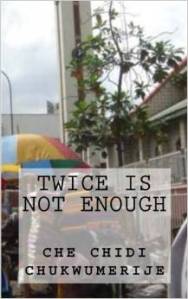
amazon cover copy twice is not enough 2015

MANDELA, LEARNING FROM OTHERS’ MISTAKES: 11 – (Africa, Unite)

At independence, South Sudan’s problems were and are daunting – but no more daunting and unique than the situation in the majority of African nations at their independence also, five decades earlier. Thus, everything happening in South Sudan today – South Sudan and the African Union (AU) should have seen this coming. That an organisation which has spent decades operating as a rebel group is going to have difficulty transforming itself overnight into a legitimate, democratic, parliamentary government is self-explanatory and has antecedents in Africa and the world. That a poverty-and-famine-stricken, largely peasant, oil-rich, infrastructurally poor, multi-ethnic nation, newly sovereign, without the familiar ancient common foe to unite against, is going to need the selfless Service of a revolutionary Leadership that makes the people understand that division, egocentricity and disintegration are the new common foes which they have to unitedly defeat now, is a lesson history has taught us. Not the familiar endless paper-rounds of ceasefire agreements will bring salvation to this new State now, and salvage and build upon whatever is left of the momentum of independence, but the self-sacrificial and deeply clear will of a Leadership that sounds the bell of reconciliation and genuine participatory upbuilding across the length and breadth of the land, in every South-Sudanese soul. Now more than ever, South Sudan needs leaders who think and act like Nelson Mandela.

No-one can tell if in the near or distant future, new African states will or will not break out of the existing, arbitrarily created, states of tension left behind by colonialism and in turn become “independent”, or whether a deeper calm will gradually set in within these countries of myriad states as they meld into functional united nation-states – but in the unpredictable nature of human history, who can tell? Yet one thing is for sure: no matter what happens, each state of tension will either bend to the gentle force of “Mandela-like” minds within its polity that push towards painful and tedious reconciliation, unity and harmony, or it will disintegrate sooner or later into internal chaos, like the majority of “independent” African nation-states all did, and like South Sudan is also now going through. There are those that will tell you that chaos is the necessary precursor to order; but six decades of African independence would also suggest that chaos, unchecked and unpacified, simply continues to beget even greater chaos.

The African continent is a kaleidoscope, a jigsaw puzzle, of hundreds of tribes and ethnic groups. If the continent does not intend to end up ridiculously splintered into innumerable mostly micro-mini single-tribe pseudo-nations, at odds with one another, weak, open to rape, exploitation and so-called “intervention”, then our countries and nations are bound perforce to remain multi-ethnic, multi-lingual, multi-religious and multi-ideological. There is nothing we can do about it – this is the state in which we crossed path with the modern world. Of all continents, Africa above all is damned to unite or perish. Africans have no choice but to learn how to live in unity if they do not want to self-destruct and be eventually gradually re-colonised, steps towards which are already being actively, if surreptitiously, undertaken – economically, militarily, politically. Re-colonised by all those loving donor nations, East and West, who like to break bread into crumbs and miraculously shower us with fish, but never really teach us how to fish. Because, I guess, why should someone else teach you how to fish? –

But, watch fisherfolk when they go out to sea: to be successful, they do it in unison, in unity.

Christian or Moslem or Animist or whatever other faiths we differently follow, whatever our different tribes, our different tongues or our different races, our orientations, our ideologies, or our classes… the song is simple:

Africa, unite.

Che Chidi Chukwumerije.

Preceding Chapters:
MANDELA, LEARNING FROM OTHERS’ MISTAKES: 1 (Preamble)
MANDELA, LEARNING FROM OTHERS’ MISTAKES: 2 (Egypt’s Modern Pharaohs)
MANDELA, LEARNING FROM OTHERS’ MISTAKES: 3 (Tunisian Troubles, Libyan Losses, Ethiopian Woes)
MANDELA, LEARNING FROM OTHERS’ MISTAKES: 4 (Sudan and South Sudan)
MANDELA, LEARNING FROM OTHERS’ MISTAKES: 5 – (Ghanaian Black Holes & Ivorian Time Bombs)
MANDELA, LEARNING FROM OTHERS’ MISTAKES: 6 – (Nigerian Nightmare & Congolese Chaos)
MANDELA, LEARNING FROM OTHERS’ MISTAKES: 7 (Ugandan Up-n-down)
MANDELA, LEARNING FROM OTHERS’ MISTAKES: 8 – (Angolan Angers, Zimbabwean Tragedy and a host of others)
MANDELA, LEARNING FROM OTHERS’ MISTAKES: 9 – (Sharing Power and Passing it on)
MANDELA, LEARNING FROM OTHERS’ MISTAKES: 10 – (Jasmin Revolution and repeated mistakes)

ADULT AND LOST

A gentle feeling of lullaby
A soothing wave, a beast asleep
A little child is passing by
Why does it weep?

Tears as large as sun and moon
Bright as heart, dark as dream
Butterfly trapped in a cocoon
Life is vanishing cream

We spend our youth growing old
Learning sophistication, hardening up
The night grows empty, proud and cold
Saddening up.

But precious moments will come sometimes
A tear, a thought, a child’s pure heart
A Memory, a bell that suddenly chimes
And tears your heart apart

Those who find the child again
Do so because they looked again
Through clouds of lies and inner pain
And wiped its tears of pain
And became normal again.

– Che Chidi Chukwumerije.

RIDE OUT

The way is “how”
Even more than “what”
Even more than “where”

“What” without “how”
Is religion, is dogma
Will chain the spirit

“Where” instead of “how”
Will never lead to
The answer of “why”

For it is the doing
By oneself that yields alone
The personal Understanding of “How”

Just do to me that thing
That makes my spirit light
And, deep in me, I’ll understand
The way

Who needs teachers
When we’ve got horses?
Just teach me how to ride
Or I’ll learn it myself

Then we’ll ride out together
And see for ourselves
What the world has to offer to
Seekers and lovers.

– Che Chidi Chukwumerije.

MANDELA, LEARNING FROM OTHERS’ MISTAKES: 9 – (Sharing Power and Passing It On)

(Lessons from the first (mis)steps following modern Africa’s independence)

History is the teacher of the wise. The irony of the squandered momentum of African independence is that many of our first generation independence leaders, like Nyerere, like Nasser, like Nkrumah, like Selasie, Senghor, Houphouët-Boigny, Kenyatta and the list gets longer, were unquestionably deep-thinking, patriotic, well-meaning, ideologically clear, passionately driven and courageous personalities and leaders, conscious of their calling and fired by a sense of mission. Their gravest mistake, however, was the one that Nelson Mandela was determined not to make. They disobeyed a law best expressed by a very simple African proverb: A tree does not make a forest. No matter how deep, great, and whatever other superlative you are, you alone cannot move your country forward. Everybody must be involved. Their deepest error was not economic, ideological or military – it was political. Politically they became, at best, one-sided; at worst, unilateral. But you cannot build upon a divided house. Especially when it is your calling to be the first in a new time. You must chaperone the building of the foundation for the future and lasting peace and unity of your country’s peoples. The most important first step for a newly dependent African country is unification, not divide-and-rule; reconciliation, not vindictiveness; healing of wounds, not continuation of ancient feuds. Like a practised reverse parker, the first duty of anyone who gets into power is – almost contradictorily – to prepare to relinquish that power. Only then will such a one wield that power wisely in all its poignancy and brevity. For power is always brief in the end.

In such a tribal kaleidoscope as Africa is, the primary light filter is unity. Politics derives its strength from unity and solidarity. But the leadership style of practically each of the first and second generation nationalist leaders and regimes in power almost invariably was a one-man or one-group show, authoritarian or dictatorial, forcefully exclusive of all opposition and adversary. Most of them stayed on in power endlessly until either they died there, were killed, overthrown or forced by events to hastily stage-manage a belated exit. The few who were able to avoid serious civil unrest, did it largely by their own mercurial powers of diplomacy, or sometimes by economic policies that uneasily delayed the effects of political disenfranchisement. Economic progress without political integration is a game of Russian roulette. Every downward swing simply reminded the people that they are not united – and each time, they placed the blame on their long-winded leaders. Ultimately even the most devoted, apparently successful leaders also had to make way in order for the democracy experiment to take their place. Democracy’s joke on those who wish to bring progress is that it requires of them, above all, simply to get out of the way. And thereafter to join in and participate in the building and maintaining of a system that ensures that others too, in their own turn will get out of the way also. Politics is not kind to permanent guests.

Re-enter Nelson Mandela, in South Africa – ten years after Zimbabwe, thirty years after the euphoric year of African so-called independence – a sadder and a wiser man. And a more determined one too. If ever, in the wilderness of history, the right person was at the right place at the right time, it was Nelson Mandela. History’s quiet thoughtful student. He knew what needed to be done, and he had the heart, the intellect, the character and the experience to not just do it, but also to inspire his people to go down that road with him. The road of inclusion. The path of reconciliation. The anchoring of democracy. A bold attempt at Peace, unity and democracy. The historical chance that Mugabe, despite the benefit of hindsight, had been unwilling or unable to grasp, Nelson Mandela hungrily and wisely did. Africa needs peace, not war. Upbuilding and liberty, not oppression and suppression. Unification, not fracturisation. Reconciliation, not vengeance. Because if we go down the path of vengeance, there will be no exit from its downward spiral – for everybody has also wronged somebody else irreparably somewhere down the line. But while Africans squabble with one another, the rest of the world is rushing ahead, not waiting for them to get their act together. And now they are encroaching back on Africa, economically, politically, militarily.

Che Chidi Chukwumerije.

… continued in Part 10/11:
MANDELA, LEARNING FROM OTHERS’ MISTAKES: 10 – (Jasmine Revolution and repeated mistakes)

Preceding chapters:
MANDELA, LEARNING FROM OTHERS’ MISTAKES: 1 (Preamble)
MANDELA, LEARNING FROM OTHERS’ MISTAKES: 2 (Egypt’s Modern Pharaohs)
MANDELA, LEARNING FROM OTHERS’ MISTAKES: 3 (Tunisian Troubles, Libyan Losses, Ethiopian Woes)
MANDELA, LEARNING FROM OTHERS’ MISTAKES: 4 (Sudan and South Sudan)
MANDELA, LEARNING FROM OTHERS’ MISTAKES: 5 – (Ghanaian Black Holes & Ivorian Time Bombs)
MANDELA, LEARNING FROM OTHERS’ MISTAKES: 6 – (Nigerian Nightmare & Congolese Chaos)
MANDELA, LEARNING FROM OTHERS’ MISTAKES: 7 (Ugandan Up-n-down)
MANDELA, LEARNING FROM OTHERS’ MISTAKES: 8 – (Angolan Angers, Zimbabwean Tragedy and a host of others)

WHAT IS NIGHT?

image
What is night?
Who gave it eyes
To see my soul?

Who gave it ears
To hear my inner voice?
Who gave it the sense
To smell my fears?

What is night
After midnight?
Who gave it arms
To hold me?

Who gave it words
To answer
The questions in my soul.

– Che Chidi Chukwumerije.

Illustration “What Is Night?” by Swana van Schaardenburg.

MANDELA, LEARNING FROM OTHERS’ MISTAKES: 8 – (Angolan Angers, Zimbabwean Tragedy, and a host of others)

(Lessons from the first (mis)steps following modern Africa’s independence)

Next to South Africa and Rhodesia, the Portuguese colonies remained for many years a rallying magnet for panafrican liberation passions and efforts. In the seventies, as a result of sustained armed resistance, coupled with a sharp socio-political mood swing in Portugal, they eventually got their independence. But even they did not fare much better in the management of the riddles of independence. In oil-rich Angola, for instance, three groups had engaged in the colonial war against Portugal. As independence approached, they each laid claim to the leadership of the country and proved unable to recognise the gravity of the situation. They failed to bring up the serious will to negotiate a difficult but necessary compromise on power sharing, of anchoring the principles of democracy as well as building the institutions that support it. Instead they turned their guns on each other and, with the same fervour with which they had fought a patriotic colonial war, plunged the country into a selfish and unpatriotic civil war. Shamelessly, each side called upon both sides of the Iron Curtain for arms and help, to help them kill their fellow Angolans. The U.S. sent arms and European mercenaries, the U.S.S.R sent arms and heavy artillery, China sent arms and logistics support, Cuba sent training instructors and special forces, apartheid South Africa – launching from its South West Africa base – sent whole columns of fighting troops, Zaire and Zambia sent advice and moral support. And the Angolans made war on each other. Angola, who had just obtained liberation from Portugal, made herself into a proxy battle theatre for the Cold War, with a mix of apartheid strategic interests. Angola thereafter became the reaping fields of decades of internal unrest, bereft of the will towards the essence of democracy – i.e. compromise and power-sharing.

These are just a few examples. The list goes on, of historical examples of what happens when independence or liberation are not followed by the constitutional upbuilding of a political system, rooted in conciliation, unification and equitable sharing of power, the democratic spirit, to which the leadership – terminal and law-abiding – submits itself; leadership by example. Guinea, Libya, Togo, Benin, Central African Republic, Rwanda, Burundi – … fill in the blanks – all also went a similar way. Or be it even capitalist Kenyatta in Kenya who ruled for fifteen years until he died in Office; or socialist Nyerere in Tanzania who ruled for twenty-four years before handing over to a hand-picked successor; or Senghor in Senegal who bowed out only after twenty years and five terms in office; or Kaunda in Zambia who relinquished power after twenty-seven long years as President – all strong personalities during whose tenures, like with Houphouët-Boigny, their countries avoided the violent descent into some of the extreme forms of chaos that manifested in some other countries – their reigns nevertheless all exhibit one common feature, homogeneous with the rest of the continent. The long, autocratic nature of these foundational presidential tenures or regimes in Africa undermined the nurturing of a democratic political tradition of broad parliamentary participation, separation of powers, the repeated cycles of free elections, change of governments and regimes, rotation and sharing of responsibilities.

For more than two decades after independence, the military held Algeria in the iron grip of a one-party dictatorship that controlled political, cultural, social, religious and intellectual life, but offered no solution to the pertinent Algerian riddles. The french-algerian question, the Algerian-Berber question, the military-democracy question, the religion-state question. All these conflicts tormented the soul of the nation. Every side is convinced of its own superiority, even to this day. The concept of a solution that contains – voluntarily – a bit of everything, remains, for many, a challenge in contradiction.

“You have inherited a jewel. Keep it that way.” These were the words of advice that Tanzania’s Julius Nyerere is reported to have given to Robert Mugabe as he became the first democratically elected leader of the new free state of Zimbabwe. And yet… even Zimbabwe, which, dropping the oppression-name Rhodesia, became free and independent a full twenty years after the African year of independence, did not learn anything from the events of those two previous decades. As though Africa had no recent history from which she could learn, Zimbabwe promptly repeated the mistakes of other African nations before her. Robert Mugabe had been in power for ten long years by the time Mandela was released from prison in 1990; for fourteen years by the time Mandela became president of South Africa; for nineteen years by the time Mandela stepped down; and is still the leader of Zimbabwe even today, after Mandela’s death. In this year of 2016 Robert Mugabe celebrated his ninety-second birthday, and yet, despite internal and external pressures on him to let go of power, in the face of decades-long manifold accusations of bigotry, nepotism, oppression and bias, he continues to insist on the perpetuation of himself in office. In quiet moments what must he think when he reflects upon how his friend and mate – Mandela – handled his own country’s transition? Mugabe himself was also once a freedom fighter who endured eleven years of imprisonment at the hands of his people’s oppressors before independence. Yet, when he became president of a liberated Zimbabwe, he also ended up squandering the momentum of independence, doing everything other than create a broad-based conciliatory democratic upbuilding that could have harnessed all the strengths and potential of this great country’s diverse peoples. Today he presides over an impoverished, divided, isolated, tense Nation.

UPDATE: In Nov 2017, One year after this article was written, the Zimbabwean Army unceremoniously ousted old man Mugabe from Office as he continued trying to clutch onto power. He was deposed, and died two years later in the well-equipped hospitals of a foreign land.

Che Chidi Chukwumerije.

… continued in Part 9 of 11:
MANDELA, LEARNING FROM OTHERS’ MISTAKES: 9 – (Sharing Power and Passing It On)

Preceding chapters:
MANDELA, LEARNING FROM OTHERS’ MISTAKES: 1 (Preamble)
MANDELA, LEARNING FROM OTHERS’ MISTAKES: 2 (Egypt’s Modern Pharaohs)
MANDELA, LEARNING FROM OTHERS’ MISTAKES: 3 (Tunisian Troubles, Libyan Losses, Ethiopian Woes)
MANDELA, LEARNING FROM OTHERS’ MISTAKES: 4 (Sudan and South Sudan)
MANDELA, LEARNING FROM OTHERS’ MISTAKES: 5 – (Ghanaian Black Holes & Ivorian Time Bombs)
MANDELA, LEARNING FROM OTHERS’ MISTAKES: 6 – (Nigerian Nightmare & Congolese Chaos)
MANDELA, LEARNING FROM OTHERS’ MISTAKES: 7 (Ugandan Up-n-down)