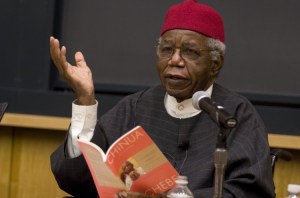
CHINUA ACHEBE: THE MAN WHO CHANGED THE CONTEXT OF THE CONVERSATION

image
“If you don’t like someone’s story, write your own.”
– Chinua Achebe.

When you see a well-cleared road through the jungle, it is sometimes hard to imagine that once upon a time there was no road there, only trees and bush. To put it differently, when you see a jungle in front of you, it is sometimes hard to see a road whose past was a jungle. So stoic and self-justifying in its impenetrability that it would never have occurred to anybody that this jungle has no right to block our path; that anywhere we say “Let there be road”, there will be road; that it is not for the jungle to blind us to our possibilities, but for us to open the jungle up to our needs; that we have the right and the ability to choose and determine the range of our options by ourselves; that it is not the task of roadlessness to indoctrinate us from birth into the stupor of its own inevitability, but for us to be immune to the concept of “roadlessness”, and learn to see the obvious: it is man that defines himself.

But once in a while, a person comes alone, a special mind of deep intuition struck by an unaccountable thought. What if I am not who they say I am? What if I am something else? What if this jungle is not what we assume it is? What if it is a road dressed up with trees? What if that “mirror” they’ve placed in front of me is not a mirror, but a painting of what they want me to think I am? What if I now make my own mirror, with which my kind and I can see ourselves as we really are – what would I then see? What if the freedom they’ve given me is in truth a mental prison? What if the education they’ve brought to me is in truth a software of mind-control? What if?…

Once in a while, a person wakes up because the “What if?” moment has taken root in his consciousness. And, like a mustard seed, the “What if?” question will mature into a “Yes, indeed” answer in this person’s mind. And this person will become a leader. This person will part the red sea of somnambulism. This person will turn the mirror around. This person will change the context of the conversation. This man will open a road where others saw an impenetrable jungle. This person will rid the obvious of its garb of concealment, allowing it to arise in all its naturalness and normalcy, so intoxicatingly immediate, this simple truth: we are not who they say we are, we are who we know we are.

Pioneers and groundbreakers like this are very rare and far-between. But every once in a while, they step on the stage, to nudge the development of a people’s consciousness one step forward, creating new inner living spaces for the growth and flourishing of generations of consciousness.

Such a person is Chinua Achebe.

Many things fell apart when his first novel appeared; above all, the tight bind of redefinition wrapped around the thinking and perceiving faculty of the average colonised and educated African. It began to unravel, spearheading in its wake a generational surge for self-re-redefinition that did not stop with the generations that midwifed its birth, but has transplanted itself from generation to generation. Like every unravelling, it has been untidy. We know what we were. And we know what we aren’t. Armed with these pieces of the puzzle, we struggle to attain the living definition of the question: Who are we? A journey buffeted by the twin helpers of self-pride and self-criticism as we travel on along that road cleared through the jungle by vanguards such as the late and forever unforgotten Chinua Achebe.

– Che Chidi Chukwumerije.

TENDER SPOTS

There is in me a very soft spot for naked tables and chairs, pens and empty sheets of paper, and a feeling that if I do not write the poem write now, it will never come again. It is a very special soft spot and very dear to me, sees me through lonely nights and empty restless days and times of unfocused focus and focused unfocus and is much better than many other a pleasure.

The heart is inside, the voice outside, and a strong voice without a heart is as baseless as the pointlessness of a voiceless heart, burning and knowing and mute. I have a very soft spot in me for that quick tender urge that would have me run again, a pen upon waiting sheets, a snow-lion stalking buried treasures, a singer learning and singing new songs, simultaneously.

Water is the king and when your heart runs like water, poetry becomes an uncheckable force – everywhere you hear it… everywhere you hear it. It follows you, it enters you, it captures you until you have mastered yourself in it, then it sets you free to roam again. Yes, this is my jungle.

I have in me a so soft spot for that glowing star, yonder flame that has decided to call me Home. Yes, Song, let it ring, and with my life I will follow, poet and musician and man. There was a beginning but, I vow, there shall be no end to eternal tenderness inside you and me.

– Che Chidi Chukwumerije.

FROM INDEPENDENCE TO SELF-DEPENDENCE

The news around town is that another Nigerian is claiming to have found a cure for AIDS. Again. Social media shakes its head and reminds us of Dr. Abalaka. Lone voices call for more funding, more testing. Experts take a strong look and immediately distance themselves from him. A few days later, he recants and apologises for making public something still in its early phases, according to him. Everybody breathes out; one almost wonders if we’re relieved that pseudo-normalcy has been restored:  Nigerians, indeed Africans, don’t discover or invent anything noteworthy. There is always something more to the story.

But what is actually the essential thing here? As unfortunate as it is that this fiasco played itself out around something as sensitive as this death-dealing virus, it inadvertently brings to light another matter at the core of our continental drift. Be it in medicine, in technology or in any other field necessary for the structural upbuilding of nations. Very simple: how long will we remain dependent on the solution-finding endeavours of others? I thought Independence had another meaning. But since it seems Independence, as a word and a concept, has over the last five decades of Africa’s ‘independence’ surrendered itself to another definition – one that includes inefficiency, beggarliness, corruption, division, non-productivity, squandermania, boastful pride and retrogression – and thereby lost its function as a star drawing our feet forward and a compass showing the way, it has maybe become necessary to temporarily park that word – Independence – in the purifying purgatory of history and replace it with a new-crafted word that more unceremoniously exposes the well-camouflaged wound and slams the nail on the head. A term devoid of poetry and romance, simply being stable and as unmistakably understandable as black-and-white.

A word that very clearly states, describes and defines what we did not get in 1960 when we became independent; nor in 1963 when we became a republic; nor in 1970 when we got the task done of keeping Nigeria one; nor in 1979 when we returned to democracy, new constitution in hand; nor through decades of near-uninterrupted military rule; nor have we found or got it since 1999 when we AGAIN returned to democracy, remixed military constitution again in hand; and even until today we still have not got it. Let us call this word: SELF-DEPENDENCE.

It is the perennial bane of Africa, a continent of people who claim to be the birthpoint of humanity, of civilization and of technology that every modern contraption of essential value which is required for its growth in a modern world, is invented and made on other continents and then freighted into the cradle of civilization at high prices or – even worse – as donations. How many times have we heard the lectures about the great people who built pyramids on the banks of the Nile and then migrated to the banks of the Niger, by which time they had apparently forgotten how to build pyramids because here they started to build huts? Or of the great empire-builders of Mali and Zimbabwe whose descendants, perhaps patronized by the mental version of the tse-tse, steadily slumped into the generational amnesia that rendered them incapable of matching, talk less of outdoing, their forebears?

Truth be told, such tales bore the tears out of me. I’m more interested in other, more recent, exploits, uncelebrated and often greeted with perfunctory yawns of tired amusement at best; but even more often with suspicion, ridicule and denunciation. A tinkering family member of mine and his colleagues designed some new technical thing – don’t ask me what, all I know is that it has to do with computers – but they went ahead and patented it; now some firms want it – apparently it’s the solution they’ve long been looking for. My former secondary school classmate developed with his team a breakthrough procedure for extracting the cells that make up the blood-nerve barrier (if you’re confused, don’t worry, so am I), but it permits an important step forward in understanding peripheral neuropathies, which affects millions of people worldwide.

Some months ago I read of some tenacious eccentric young man in Kaduna State, in northern Nigeria, who has been trying to build a rocket since he was a kid. His last effort did not fly very far, but it flew. The news gave me a thrill. My friend from the south did not know exactly what to make of that piece of news, cautiously asking me in which cardinal direction I thought Boko Haram would first direct that rocket if after the young man ever perfected it, BH stepped in and confiscated it. My answer: don’t worry about that – once one African builds a rocket, another will soon build a magnetic return-to-sender shield. The thirst to invent and build just has to be set free first of all, and encouraged and supported – morally, culturally and financially.

A few years ago I read the amused article of a journalist reporting on another young man, this time in Onitsha in eastern Nigeria, who had designed and built his own version of a helicopter. The writer wondered who would be the first daredevil to attempt a test-flight. And then it was on facebook not long ago that the link to an article was doing the rounds, a report on the scientific tinkering of some secondary school girls in Lagos, in western Nigeria, who had tinkered an electricity generator powered, not by the black curse called petroleum fuel, but by urine. (You read that right). Let’s not go into the jokes people cracked about that. The generator worked, by the way. If you understand anything about the mysterious fuel cabal in Nigeria, you’ll know why this news might cause some powerful people sleepless nights and blocked urethrae.

Tell me more of these stories – these are the ones I like to hear. Why? Simple. How long will we fill our lazy stomachs with the swelling garri of empty pride, back-dated? Must every good thing exist only in some distant dusty past painstakingly reconstructed by dogged historians? What of the future? Who designs it? We don’t need to re-invent the past; we simply have to invent the future. Now, the reason why we should do this, surprisingly enough to the unbelieving, is not even pride. It is more practical than that. It is economic. (The economy, stupid 🙂 ). Long-term sound economics. What is at the core of that which makes a 1st world country a 1st world country? Not the appellage, not the climate, not money, not weapons… but simply the power and the ability to INVENT. The urge as well as the consciousness of the necessity, constantly put into deed, to create new things, to find new self-made solutions, to imagine and anticipate future problems, to constantly improve anything that exists, be it a substance or a process.

If you cannot figure out anything by yourself, you will never be self-dependent and you will never be free, because you will always be dependent on those who do the figuring out and the making. If you cannot make anything by yourself – not just what you yourself need, which in itself would already be a giant step towards self-dependence, but also what others need – you will never be truly independent, because your so-called independence will lack the fortifying ramparts of self-dependence. Every shift in technology is a potential threat to your future stability. You remain constantly one step away from becoming a colony anew. Laugh not at those who warn about neo-colonialism. Political and military independence can be safeguarded long term only by economic self-dependence. And economic self-dependence exists truly only to the extent to which the basis of a people’s, a nation’s or a region’s wealth rests to a large degree on its own capacity for industrial and technological creation. Wealth that comes from the monetary equivalent of fossil fuels stored in the ground by nature’s forces is not real wealth. Real wealth is generated by the power to create or to make (out of something or even out of apparently nothing), to make a needed end-product. Some people call it the power of ideas. I think it’s more than that – we all have ideas. I think it’s the culture of industrial creation; making new things and making things new. Don’t buy everything, build some. Don’t take it, think it.

This is where we have so sorely lagged behind in Sub-Sahara Africa for much too many centuries now. There is no satisfactory excuse for this. We cannot blame others for not giving us the education on time, or in sufficient depth, or spreading it around generously enough without tempering it due to ulterior motives and all the rest of that dialectic, because well they pieced it together and systemized it by themselves, or at least preserved and built upon the documentation and further development of it. We could have also done the same for ourselves over the centuries. All kinds of ethnological theories abound as to why the different continents developed as they did. Well, let bygones be bygones, we are not time-travellers. The moment is now.

Now that we have the knowledge today, why are we still importing the application of it? What will we do when technology shifts away from fossil relics and we no longer have their monetary equivalent with which to pay for the import of new applied intelligence? Is that when we will start trying to learn how to use our own intelligence? Or will we go borrowing from IMF and World Bank? Maybe ‘Independence’ is a pun for a state of living “in dependence”. We need inventors, discoverers and makers, for whatever they imagine and create – or omit to imagine and create – today, is our future tomorrow. We need inventors. Or, to put it differently, we need to identify and, as a matter of public and private policy, indeed as a matter of culture, support our individual inventors specifically and the spirit of invention generally. Institutionalize it even. The cultivation of ideas, the inventing of models, the indigenisation of industry, the manufacture of hardware, the innovation of standards, all this should become a part of our culture.  Put on your time-telescope and peer far into the distance of development: you will see that there is no other road that leads from 3rd World to 1st World.

If there be any Nigerian, indeed any African, in whom the spark of invention, the light of discovery, the visionary eye that sees the future’s questions and answers, the power of innovation and the hunger for creation dwells, then the New African Consciousness must recognise in such a person a rung on the ladder that leads out of the dungeons of dependence. You can only be a part of those who dictate things in the new world if you were one of those who invented and designed that new world.  To set our policy-compass towards the attainment of self-dependence, but also to properly understand the source and anchor of concrete self-dependence in a world increasingly run by the power of ideas, constantly churned into an unending cycle of research and development, this is the nature of the new struggle. The spark of genius rests in the fertile soil of even the most simple mind. Parents, guardians and teachers: encourage your children and wards to join this struggle. Leaders, encourage your people to join this struggle. It is the struggle for self-dependence. Aluta continua.

Once we fought externally for independence. And, according to our definition of it, we got it. But we forgot to also fight internally for self-dependence. Simply put: we became independent, but we never became self-dependent. And it is just like freedom – if you don’t fight for it, you won’t get it. In other words, you cannot get what you have not fought for. You cannot defeat an enemy you have not properly identified. The journey did not end in 1960; it continued: the journey from independence to self-dependence. For what is independence without self-dependence? Nothing. Unsustainable.

And OK, I admit I lied; it’s not just about economics. It’s also a bit about pride. The kind of pride I sensed in a reporter of African descent who I saw on TV not long ago happily interviewing a group of Ugandan university students who had built a functional, beautiful, mobile, modern electric car. The best part was when he asked them why they chose to build an electric car instead of a petrol or diesel engine car. They said, because electric cars are the future. No point building the past.

– Che Chidi Chukwumerije.

MASKING MASKS

What you see is but a mask, not a face, not the true face, but a mask, a facade, masking the first mask, the true mask which once upon a time was the face of a human soul. But now it’s a mask, the real mask, masking nothing again but emptiness. The mask becomes the life, the life becomes the mask, masking everything, but unable to mask our emptiness.

So when you finally succeed in unmasking one, it would do you good to bear in mind that the face you discover underneath is again nothing but another mask. And you keep unmasking them, one mask after another, one lost dream after another, one tomb after another.. and all you see are masks, masking masks, round and round the mulberry bush. And when you finally begin to ponder and wonder: But where then is the human, the wearer of all these masks? Where are we? What are the masks hiding, then, if all we encounter are masks?…

Then, dear friend, you must understand that the ugliest of all these masks is now the human being himself, and what we are hiding is the fact that we have lost our true face forever.

– Che Chidi Chukwumerije.

UNDERSTANDING YOURSELF

You will find, strangely enough, that you actually secretly desire the downfall of the person, place or thing that you love.

You will find, strangely enough, that the person you hate is the person you love; and the thing you fear is the thing you hope for; and the place you leave behind is the place you are going to.

You will find, strangely enough, that your friends envy you, and you envy your friends; and your enemies admire you, and you admire your enemies.

You will find, strangely enough, that you long for what you cannot have, and disdain what is easily yours; and already you have what you are still seeking for.

You will find, strangely enough, that the biggest fool is inside you and the wisest sage resides there too, and the fault which you can tolerate the least in others is the very one which you finally have the most.

You will find, strangely enough, that love is like the air and, thus, everywhere – and, like the air, sometimes you breathe and sometimes you suffocate.

And I also wonder why the other world always seems more intriguing to the person just coming from it.

What am I looking for? Anywhere I go, you go. And, in the end, you will call me your teacher, your helper, your friend. But I, I cannot help but try to understand what happened to me as I fell.

You will find, strangely enough, that even after I’ve hurt you, you still love me; and after I’ve healed you, you still detest me; and after you’ve comprehended me, you still fear the unknown side of your destiny.

So why not just open up your eyes once and for all, and do it all over again – and, this time, do it right.

You will find, strangely enough, yourself.

– Che Chidi Chukwumerije.

I MET AND LEFT A MOUNTAIN

There you see her, over yonder, bathed in beauty and love… it is the beautiful mountain which I once peaked – wild and calm, primitive and yet new and fresh, a restorative to my battered soul.

But when it was time to move, I discovered that I could not take the beautiful mountain along with me, however hard I tried; so I left her behind and journeyed on. Yet, strange to say, with each step away from her that I take, she comes more alive, grows bigger and bigger within my heart – because when I left her behind me to find the Tomorrow Mountain;… when I forsook her for to seek the next peak;… I took her along. But if I had stayed with her, then in truth I would have departed from her. And, tomorrow, when I crown a new beautiful mountain, she will also be there, for all true mountains unite at every distant new peak again.

It is hard to explain in words the things which we harbour inside of us. I too try and try, but ever and again I fall short of fulfilment. Why? Where did I go wrong?

Tomorrow is the only friend I have.

– Che Chidi Chukwumerije.

INTO THE SECOND CALM

A period of difficulty, well endured with reflection and honesty, will awaken calm within the soul. Calm brings clarity.

If you continue to rise higher while calm, you will one day break into a second world of utter confusion which jumps upon you just when your calm reaches its peak. This second confusion is the most difficult path, because it confounds your new knowledge and laughs at your newfound calm. At its height, you will lose all hope.

If, however, you remain calm, even in the heart of your confused hopelessness and hopeless confusion, something New will awaken within and overtake you, and set you free, reborn. Because from the valley the next step is upwards, provided you have not first buried yourself in dejection in the valley.

Even when there is no hope, yet continue to hope. Even when you are broken, and rebroken, yet trust in life. – And you shall enter into the Second Calm. And, come what may, nothing and nobody can take away this Calm from you, because it is the other side of pain, where spirit dies no more.

– Che Chidi Chukwumerije.

WISDOM

Wisdom. To see the limitations of others, and see the limitations in myself which stop me from seeing the limitations in others.

Wisdom. To accommodate the faults of others, and to accommodate the faults in myself which prevent me from accommodating the faults in others.

Wisdom. To understand the confusion of others, and understand the confusion in myself which blocks me from understanding the confusion in others.

Wisdom. To fathom foolishness, and fathom that which can never fully fathom the foolishness of man.

Wisdom. To be aware of my ignorance, and of my knowledge, and of the difference between the two.

Wisdom. Lord, make me wise in Thine Ways. Amen.

– Che Chidi Chukwumerije.

HOW DO YOU STOP LOVING SOMEONE?

How do you stop loving someone? How do you forget her eyes and her face and her secret smile and the unwordable look she bears upon her countenance?

How do you stop loving someone? How do you forget the times shared? How do you forget the Love, the eternalness of your togetherness? How do you make it right forever?

How do you stop loving someone? How do you uproot love from your soul? A love that wants to remain. Someone who loves you so. A union that begs for fulfilment. How do you not continue an ancient story in a modern world? How does an old tune not give birth to a new tale? How does a stream die?? It just resurfaces in other places…

How do birds of one wing not visit heaven together? How does loneliness not seek itself? How does fire not burn? How do sowed seeds not grow? How can you restrain the moving sun, unless you first stop the rotation of the earth…? But then how so many other people die, how many other things are lost?

How do waterfalls desist from falling? Two elephants in one heart, two hearts in one elephant. If you kill the elephant and open the heart in order to understand this phenomenon, what if they all die, elephants and hearts?

How do you stop loving someone? I don’t know.

– Che Chidi Chukwumerije.

WISE SAYINGS AND ORDINARY PEOPLE

A stitch in time saves nine. –
Where are the nine in need of salvation if the one has already been saved? Find one good person in Sodom and Gomorrah, and destruction will be stayed – one good person. Just one. Is there a good person on earth?

All that glitters is not gold. –
Why aren’t they all gold if they all glitter like gold? And why does gold glitter, were it not also gold? Gold glitters because it is gold. But humans glitter because they are not gold. Good people are silent, walking unnoticed. Golden hearts do not require additional glitter to shine. The shine inside.

In November, trees and people reveal who they really are. –
In the eleventh hour, the power of humans to deceive shall begin to fail, and Creation’s autumn shall brutally strip all naked and cold, and we shall see ourselves as we are. If I deceive you, I will come naked to you tomorrow, asking for warmth. Please clothe me.

Every saying is wise, but it would be very unwise of their poets to presume themselves in any way to be sages or wise people. That would be foolishness.

– Che Chidi Chukwumerije.