REALPOLITIK: AFRICA, THE REAL AFRICA

01C4E175-5A82-4DE4-904A-D4D84B7BA94D
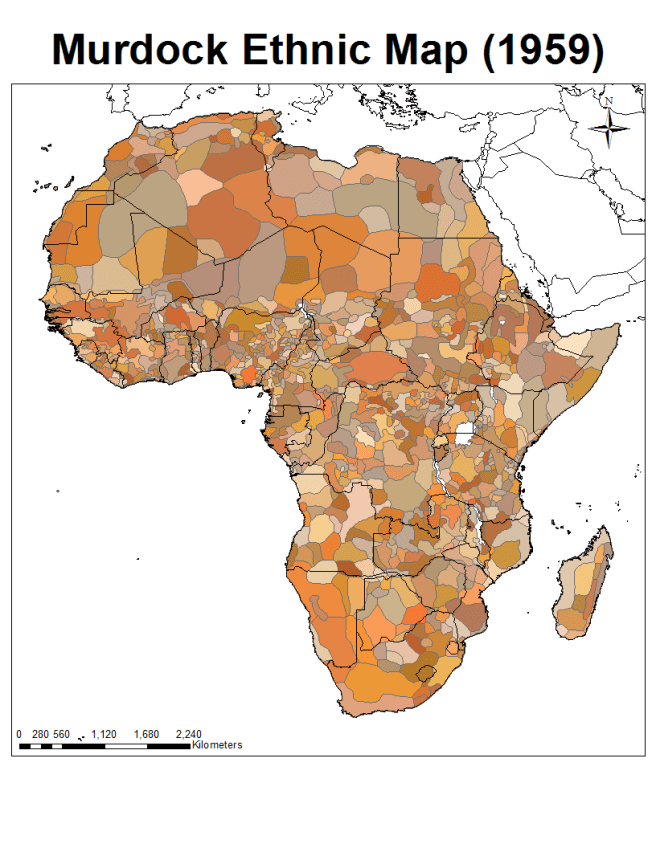
African Unity is Inter-ethnic (not Inter-national) in nature. Unlearn Africa. Learn Africa. Know the tribes and ethnic groups, their languages, histories, cultures, sentiments, traditional friends and enemies. Then you will suddenly see the real Africa and the real African boundaries and borders. They are very different from what was left behind by colonialism. Still unresolved.

African peoples and ethnic units, the real ones, not the national mirages. Any African countries that scrap their tribal languages are taking a lazy defeated step backward, not forward; suppressing forces that will still break out one day again – with even greater force. You can not deny Ethnicity in Africa.

But it does not have to divide us. On the contrary: the acknowledgment and knowledge of it helps us to form natural bridges across ethnic lines. This leads to more – and true, natural – peace and understanding. On the other hand, ignoring it has led to us over and again walking blindfolded and naively into pogroms, genocides, wars at worst – or just never-ending fractures at best.

However, in our need to find peace we have often taken the self-destructive path of sand-papering all our ethnic identities away in order to reduce us all into one amorphous history-less post-colonial European-speaking being. But we thereby go backwards, or sideways, not forwards. We lose, in the illusion of gaining. You have to know your tribe and your fellow African’s tribe; and allow the ethnic part of you to forge ties and forms of understanding with the ethnic part of them. Because our ethnic identities is what we on our own developed for ourselves over the course of millennia. They are not just surface-identities and nothing. Our colonial identities, however, were imposed on us and still sit on us like ill-fitting clothes.

It is ironic that when we associate with non-Africans, we make room for differences based on race and ethnicity. We acknowledge their race and take it into account in the bridge we build between us and them. This then smooths the way to a firm relationship and makes it easy for the shared humanity in us and them to link up with each other. But when we progressive Africans are associating with our fellow Africans, we carelessly believe the colonial white-wash of the irrelevance of our original ancient ethnic identities, and we try to build a relationship on an illusory foundation within which we have not yet reciprocally understood and arranged our minor but important ethnic differences according to their natures. But: Once done, harmonisation becomes very easy and in fact inevitable.

One of the reasons why Igbos and Yorubas, for example, quarrel so much and seemingly find it so difficult to unite politically is that they each keep on expecting the other, unconsciously, to be like them. To be the same end-product of colonialism. To be another version of themselves across the Niger. Especially politically. But since this is not the case, they CRITISIZE that which is different in the other. However only when they have have acknowledged and accepted not only the differences, but the fact that it is natural and complimentary to be different, will they – upon then understanding how to harmonise those differences – begin to see their vast Similarities too.

Despite being the victims of the same conditions all over Africa – corruption, mismanagement, abuse-of-power, and indiscipline – yet we find it difficult to form a strong fist to punch against these situations; and we don’t know why, although the answer is staring us in the face and we are living it everyday. We bunch ourselves into our ethnic groups and then say that tribalism is the problem. But tribalism is not the problem, because most people will always be true to their ethnic identity. It is natural. The problem is that the template for African Unity was created by non-Africans for economic purposes – today we call these templates “African Countries” and they are the member states of the so-called AU (formerly called OAU).

However we Africans need to create alternative theaters and templates of unification and conflict-resolution where the ORIGINAL African identities (today called ethnic groups or tribal families) can themselves work out the rules of engagement or disengagement. Then they can do away with Tribal or Ethnic BIAS. Denying this fact will change nothing, as the Realpolitik in Africa will nevertheless calmly continue to run along those lines and be powered by those forces. Thus, there needs to be a theatre and a dynamic where and whereby this reality can interact with itself and sort itself out.

That is what is still missing: an African self-made Inter-Ethnic OAU. An AU of the original ethnic families. Because the truth is this: the different constituent parts of it are already there. Look at Nigeria: Biafra, Arewa, Oduduwa, Bini Cosmos, Middle Belt. Some even extending naturally beyond the borders of Nigeria. They are all there, the true power blocs and centers of force; the true African identities of the Africans living there. Their FIRST socio-political and cultural identity. Nigeria is in this regard only their second identity. But as long as the first identities find no platform to engage according to homogeneity and share power equitably, the second identity will also know no peace and will remain unstable.

– Che Chidi Chukwumerije

UNDERSTANDING AMONGST AFRICAN PEOPLES

Although Africans call themselves citizens of the 55 member states of the African Union (AU), the conflicts do not take place on that level. The conflicts, suspicions and animousities manifest on the level of the original African nations that existed before the advent of European and even Arabian-style colonialism. Those original Nations, still very much in existence, are today called Tribes and Ethnic Groups – and their indigenes, even in subsequent generations, and even when they can no longer speak the indigenous language, still often feel deeply beholden to them, or are made to feel so, or are made to understand that they are seen to be so.

And yet, although this is the level on which, national-identity-wise, insults and patriotism are most deeply felt, there is no medium, no active Organisation, no Instanz, no consciousness, no consensually constituted Authority, to mediate the debate, the cooperation, the healing and the upbuilding on that level.

Any mention of this is equated to a threat against the colonially created Nation-states, with the corresponding reactions of fear or uncertainty that this thought awakens, depending on the nature of the dependancy-or-exploitation-relationship each person has with a particular Nation-state. It seems as if Africams have become so weak or deeply afflicted by Inferiority Complex that they have no sense of self-confidence in managing or developing their affairs upon any other stage than that designed for and given to them by Non-Africans; even in matters regarding the interacting of their own core identities – core national identities and languages that formed and developed over centuries and eras.

The AU is not the equivalent of the EU. Whereas it is largely native indigenous European peoples who, under the appellage “nations”, are the member units of the EU, it is completely the oppposite in the AU. Here it is the colonially born countries that are the members. With the result, that the actual African peoples themselves, the indigenous nations, have no theatre of Consensus and thus no voice. This is what is direly missing on the African continent: A Union of African peoples. The sheer number of different african indigenous nationalities should not daunt us to the task. Conversely it only shows us the potential for misunderstanding and conflict which has been exploited for decades. It is simultaneously also the potential for harmony and would be worth every ounce of effort put into it. Anything to foster and further peace and understanding in Africa is of prime importance now.

– Che Chidi Chukwumerije

MANDELA, LEARNING FROM OTHERS’ MISTAKES: 4 – (Sudan and South Sudan)

(Lessons from the first (mis)steps following modern Africa’s independence)

Those who have a knowledge of post-independent Africa will, sadly, not be surprised by the turn of events in South Sudan today. Macabre, but true. Indeed, they would have expected it and, like Mandela and his team, and they would have prepared for it, to try and avert it. South Sudan’s road to independence has been long and winding. She began her life in the modern African world as a region of an arab-dominated Sudan which was herself the joint colonial property of Egypt and Britain. Even before their first modern independence – that of Sudan from Egypt and Britain – Sudan was divided into an arab-speaking islamic north on the one hand, and on the other hand a south full of a myriad black tribes speaking different tongues, mainly Christianised, partly adherent still to ancient African religions, and basically lacking a sense of united nationhood amongst themselves. What united them was their wariness of the north in the face of a long history of slavery and jihadic wars; whereas the north itself was focused on achieving independence from its external colonisers. And independence indeed eventually came, but it did not bring peace with it. Acrimony between military and politics, disputes between Marxists and non-Marxists, moslem-christian religious animosities, and the distrust between north and south, ensured that years of coups, civil wars, genocide and violent disunity would follow. Decades after independence, seemingly unable or unwilling to find a lasting workable peace between north and south, in 2011 they parted ways acrimoniously. Soon after, in the newly independent and sovereign South Sudan, the very same quarrels, accusations and maneuverings that had plagued newly independent African countries five decades earlier, reared their stubborn heads here too and South Sudan degenerated into a hydra-headed civil war. Finally, the tribes of the South, lacking any other external adversary, seemed all too willing to turn their guns on each other and destroy what it now seems that they never had nor ever really tried to cultivate during the decades of tribulation: internal Oneness, inter-tribal political unity. And, unfortunately for them, it seems that they, too, have no Madibas amongst them.

Take any African region, north, west, east and south, and study its collective post-independent or post-liberation history. Examples abound, enough of them. The wound cries out like a disjointed pack of scattered wild voices screaming from a burning house: the lack of reconciliation; the lack of representative, inclusive democracy, of socio-political unity. Some will call it the lack of national common sense. In Africa, for some reason, political office is not voluntarily terminal, whether or not the constitutions stipulate such, and power is not shared. Leaders seem to love only the concept of their country, the fact of having a country, but do not also love all the peoples of the country, their welfare, their liberties and their peacefully united future – not if it requires that the rulers and their support groups themselves equalise themselves with the rest of the country and subject themselves to a rule of law that stands above everyone. Instead, everybody wants to grab the crown, and sit on the throne, and then ostracize, under-develop and punish his enemies. No matter what effects this has on the country in the long and short run.

– Che Chidi Chukwumerije.

… continued in Part 5 of 11:
MANDELA, LEARNING FROM OTHERS’ MISTAKES: 5 -(Ghanaian Black Holes & Ivorian Time Bombs)

Preceding Chapters:
MANDELA, LEARNING FROM OTHERS’ MISTAKES : 1 – (Preamble)
MANDELA, LEARNING FROM OTHERS’ MISTAKES : 2 – (Egypt’s Modern Pharaohs)
MANDELA, LEARNING FROM OTHERS’ MISTAKES : 3 – (Tunisian Troubles, Libyan Losses, Ethiopian Woes)

MANDELA, LEARNING FROM OTHERS’ MISTAKES: 2 – (Egypt’s modern pharaohs)

(Lessons from the first (mis)steps following modern Africa’s independence)

History is the teacher of the wise, and Mandela himself proved to be a good student – for he had many dramatic examples to learn from. Long before South Africa’s struggles for liberation from apartheid yielded fruit, other African nations had shot out of the starting block, propelled forward by the momentum of independence and freedom, to grapple each with the daunting task of forging a modern nation-being. It reads like a soap opera, one unresolved episode after another, with dependable repetition. A few examples suffice:

In newly independent Egypt, the leader of the revolution Colonel Nasser, despite his political victories against Britain, his Suez heroism and his Sinai vicissitudes, despite his enduring popularity at home and abroad, his inspiring effect on colonised nations worldwide, his influence on the afro-arab stage and the cultural boom that his tenure occasioned, was reluctant – when it came to internal affairs – to allow or foster the blossoming of a political system in which his personal power was anything less than absolute. He crushed all opposition parties, be they communists, capitalists, muslim brothers or any other grouping critical of him. He imprisoned thousands of opponents, including some who had been his comrades in the revolution. He centralised the planning of the economy, nationalised industry and everything he could nationalise, controlled both state and government, and placed a tight grip on all types of unions and institutions, from academic, to religious, the media, to the youth. He became, in effect, the modern-day pharaoh. By the time he died, in office, in 1970, after fourteen years as president, he had written his name eternally into the history books of not only Africa, and had attempted to industrialise and modernise Egypt; but also, portentously, he had practised largely only political repression during his reign. He did not use the momentum of liberation to propel all sides of the country into the forging of a political culture of unity and inclusion. Very simply, he had omitted to lay the foundation for a balanced political system of representative, rotational, shared democracy – an omission, the after-effects of which still plague a restless, internally unreconciled Egypt to this day. Nasser was succeeded by another military veteran, Sadat, after whose assassination many years later another soldier, Mubarak, took over. In 2011 the people arose in a popular revolution against him. The Revolution culminated in the election of the Muslim Brotherhood’s Mursi who, after more violent protests, was ousted in a coup-d’etat by his own head of Armed Forces Abdel Fattah el-Sisi who in turn a year later transformed from Military leader to civilian president in an election boycotted by most other political parties. Despite being one of the most ancient civilizations of mankind, and an independent modern nation, Egypt is today still struggling to find internal reconciliation, peace and socio-political harmony.

– Che Chidi Chukwumerije

(Continued in Part 3 of 11:
MANDELA, LEARNING FROM OTHERS’ MISTAKES : 3 – (Tunisian Troubles, Libyan Losses, Ethiopian Woes)

Preceding Chapter/
MANDELA, LEARNING FROM OTHERS’ MISTAKES: Part 1 (Preamble)