TALK WITH CHE: Arno Börtzler

Arno Börtzler, the chairman of the Regional Prevention Council of the Frankfurt/Main Central Train Station Area (Regional Präventionsrat, Bahnhofsviertel Frankfurt am Main) sits down to an interesting Talk With Che about the Bahnhofsviertel, Angola, Neighbourhood, Community, Integration, Migration, Culture, Music, Literature, Growing up, and Life!
October, 2025.

– Che Chidi Chukwumerije

TALK LESS OF TALKING

How do you move from talking everyday
To never talking at all? Say. Say. Say.
Because speaking about each Problem,
the say, is how to begin to solve them.

But what if speech is the problem and
Silence is the only solution close at hand?
What if talking everyday is too much
And the pauses bring the deeper touch?

Che Chidi Chukwumerije

Poems from the inner river

SEX IS NOT THE ONLY FORM OF INTIMATE CONVERSATION

Sex is not the only form of conversation, connection, exchange and sharing, in the course of Intimacy between people. There are other options that may fulfil the need for temporary or permanent oneness more effectively than sexual intercourse, depending on the chemistry between, the story around and the needs of and nature within the people involved.

1. THE NATURE OF CONVERSATIONS
The nature of verbal conversations between people can sometimes be a more powerful form of intimacy than sex, giving room for an inner release of pressures that not even sex can achieve. This often happens between people who feel comfortable enough with each other, or find the courage, to share information about their vulnerabilities with one another, and have found a language in which to do so. Some friendships bear this Quality intrinsically within.

2. SHARED SILENCE
There are some people whose most intimate exchange happens in deeply felt moments of shared Silence. This silence is like a continuum in which their thoughts and intuitive perceptions merge and shape one another. The people involved always emerge from such moments with enriched souls. These are people who of one another often say: we like to be silent together. Silence is their bond.

3. HONEST QUARRELS
A good quarrel – extreme, hard, honest, totally baring – is sometimes the best form of conversation and the most intimate way to exchange the most revealing information between two people or a set of people. I became acquainted with some of my closest friends after a quarrel. I met my wife through a quarrel. It was the quarrel that paved the way for the love. Quarrels are often missed opportunities when the people involved, while quarrelling, are – for lack of trust – not honest with themselves and with the other person. And yet sometimes the fundamental or temporary chemistry between two people is such that only an honest and brave painful quarrel will fulfil the function of the intimate conversation they need in order to take their understanding of one another to the next level.

4. HOMELINESS AND HOME
There are some people with whom we share the most open exchanges and most intimate conversations because the context of our chemistry and the base of our bond is a certain sense of home or homeliness, the type in which the real us feels ‘at home’ when together with these people. Some share this connection from birth, some acquire this in the course of a relationship or a friendship that makes them feel at home with each other. And this sense of home does not require of them to do or say anything extra or particular, or require another form of intimacy. The sense of being at home while together is in itself already their intimate conversation.

5. DISTANCE
There is a curious intimacy in distance that sometimes comes into play between certain people. It is delicate and fine, but also very intense, very strong and very revelatory. Invasion without invasiveness. Penetration without intrusion. An all-encompassing knowing, full of the most sensitive respect. The power of distance as a mediator and form of intimacy is often underrated. And yet there are some people with whom we can only enjoy a feeling and a sense of an intimate conversation when we find and keep the right distance between ourselves. Sometimes such people know us more intimately than the ones closest to us and may sometimes enjoy our rarest trust. It is also not by chance that people sometimes reveal themselves to and connect with less restriction and more satisfaction with Strangers than with those they know – exactly because of the fact that they are, and will remain,… strangers.

6. SEX AS A DEPTH OF COMMUNICATION
Voluntary sex is different things to different people – a power-game, a playful act; or for some it’s deeper, a level of release. There are people however who, apart from or in addition to this, experience sex as a form of conversation. An intimate way of sharing self-knowledge and exchanging sensitive wordless information about what we are in the primitive depths of our fundamental personalities. Just as sex can be used to tell lies, project a falsehood and hide secrets, it can also be used – by people whose bond trigger that chemistry – to communicate. People who experience sex solely in this way have a satisfying sense of communication, or frustrating non-communication, in connection with every moment of sexual intimacy.

7. A SHARED GOAL
There may be truth to the saying that there is nothing that binds people together as primordially and intuitively as a deeply-felt and shared Goal. The stronger and deeper the love and loyalty they have for the cause, the more this condition possesses the ability to break all barriers between them and link inner parts of their hidden selves with one another on levels which are never activated in their dealings with other people. That is to say: when people love the same thing and work passionately towards the same purpose, it wavelengths them into a place where only they can go together. The entire context of their relationship with each other becomes determined by that for which they share their truest love and most quiet loyalty, to which they have pledged the very essence their life, and it becomes the underlining hearth of their bond, their quiet intimate conversation.

The individual natures of each person and the chemistry between people, as well as the nature of intimacy possible, mutually desired or needed between them, is what determines the form of interchange between them which permits the realisation of this intimacy.

– Che Chidi Chukwumerije.
Undulating Plains

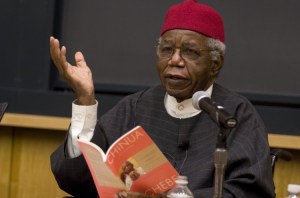
CHINUA ACHEBE: THE MAN WHO CHANGED THE CONTEXT OF THE CONVERSATION

image
“If you don’t like someone’s story, write your own.”
– Chinua Achebe.

When you see a well-cleared road through the jungle, it is sometimes hard to imagine that once upon a time there was no road there, only trees and bush. To put it differently, when you see a jungle in front of you, it is sometimes hard to see a road whose past was a jungle. So stoic and self-justifying in its impenetrability that it would never have occurred to anybody that this jungle has no right to block our path; that anywhere we say “Let there be road”, there will be road; that it is not for the jungle to blind us to our possibilities, but for us to open the jungle up to our needs; that we have the right and the ability to choose and determine the range of our options by ourselves; that it is not the task of roadlessness to indoctrinate us from birth into the stupor of its own inevitability, but for us to be immune to the concept of “roadlessness”, and learn to see the obvious: it is man that defines himself.

But once in a while, a person comes alone, a special mind of deep intuition struck by an unaccountable thought. What if I am not who they say I am? What if I am something else? What if this jungle is not what we assume it is? What if it is a road dressed up with trees? What if that “mirror” they’ve placed in front of me is not a mirror, but a painting of what they want me to think I am? What if I now make my own mirror, with which my kind and I can see ourselves as we really are – what would I then see? What if the freedom they’ve given me is in truth a mental prison? What if the education they’ve brought to me is in truth a software of mind-control? What if?…

Once in a while, a person wakes up because the “What if?” moment has taken root in his consciousness. And, like a mustard seed, the “What if?” question will mature into a “Yes, indeed” answer in this person’s mind. And this person will become a leader. This person will part the red sea of somnambulism. This person will turn the mirror around. This person will change the context of the conversation. This man will open a road where others saw an impenetrable jungle. This person will rid the obvious of its garb of concealment, allowing it to arise in all its naturalness and normalcy, so intoxicatingly immediate, this simple truth: we are not who they say we are, we are who we know we are.

Pioneers and groundbreakers like this are very rare and far-between. But every once in a while, they step on the stage, to nudge the development of a people’s consciousness one step forward, creating new inner living spaces for the growth and flourishing of generations of consciousness.

Such a person is Chinua Achebe.

Many things fell apart when his first novel appeared; above all, the tight bind of redefinition wrapped around the thinking and perceiving faculty of the average colonised and educated African. It began to unravel, spearheading in its wake a generational surge for self-re-redefinition that did not stop with the generations that midwifed its birth, but has transplanted itself from generation to generation. Like every unravelling, it has been untidy. We know what we were. And we know what we aren’t. Armed with these pieces of the puzzle, we struggle to attain the living definition of the question: Who are we? A journey buffeted by the twin helpers of self-pride and self-criticism as we travel on along that road cleared through the jungle by vanguards such as the late and forever unforgotten Chinua Achebe.

– Che Chidi Chukwumerije.

AT NIGHT…

image

Truth undresses
Conscience pricks
Contemplation caresses
What conversation can’t fix.

– Che Chidi Chukwumerije.

CAPTIVATION

I used to call you petal
Each time I pulled your lobes
And read your thoughts
Discreetly from far away in my personality
The way the farmer reads the clouds
Early in the morning

And thus you told me, without words
When to sow and when to reap
When to prune and when to weed
And when to wait with the patience
Of a farmer waiting for the harvest
Of his labour of love…

Those were the months you thought I was cruel
For the mystery of mirrors is this
The mirror cannot show you what’s
At the back of your mind. Only your lover can
When he breaks your heart
In order to get into it and conquer it

And thus did I imprison myself
For the conundrum of conquests is this
The king is the captive of his own kingdom
And when you let me break your heart
Little did I realise that you did it
Just to make sure you got me in

I came in for the kill
And never made it out again.

– Che Chidi Chukwumerije.

TWICE IS NOT ENOUGH – pt. 4

But it was the third one that she particularly liked, and she read it a second time: The Touch

Something different, something true,
Otherly, something new
Very small, something extra large,
Quietly in charge
Inside you
It is what you really are in your soul
You
Your start and your goal
Path, quest, your role
And it is, simply, you.

Someone touched her on her shoulder as she was thoughtfully reading that poem a third time. She turned around to see a young, very dark complexioned woman of about her own age peering questioningly into her face.

“Yes?” she asked, somewhat irritated.

“Sorry, I thought you were someone else. I’m sorry.”

Ada relaxed and smiled at her, then turned back to the poems. But then she was tapped again on the shoulder.

Quizzically she turned her head round again, a slightly confused, even more irritated look on her face.

“Yes??”

The young woman hesitated again, then said:

“You look too much like someone I know –”

“I don’t know you –”

“Yes, no, yes I know. Actually, to be frank, this person is a man.”

“A man?”

“Yes.”

“As you can see, I am a woman!”

“Please, don’t be offended … but … is your name Ada?”

Ada’s eyes focused sharply on the stranger. Her diction was clear and proper, she looked refined and was somewhat pretty, if not beautiful, with a small but african nose, a broad face and large, perceptive eyes. Her skin had that intense darkness that Blacks like to call ‘black beauty’.

“I beg your pardon – How did? -”

“See, I have a friend called Tony whom you resemble to a high degree and he once told me that he has a twin sister called Ada. So I was just wondering… if…”

Ada softened; and realised that everybody around them was paying close attention to their conversation; thus, simultaneously, she became self-conscious and shy. – of course!, Tony! Where was her mind! – such thoughts too raced immediately through her mind., reflected in her eyes, those treacherous windows of hers.

“You know Tony?” she asked in a lowered, nicer voice.

The young woman’s face suddenly lit up and she looked almost like a child. Radiant, naïve, open. Pure.

“Yes!” She struggled to keep her voice down. “My name is Ngozi. I knew him, er, in the university.”

“I see,” said Ada, feeling abruptly very uncomfortable. “Well, nice meeting you, Ngozi.” She turned.

Ngozi, confused, raised her hand to tap Ada’s shoulder a third time, hesitated, and then dropped it once more. Now she became aware also, for the first time, of the attention being paid her. She swept her eyes around and faces turned quickly away, conversations were struck up here and there, while a few understanding eyes surreptitiously melted friendly glances her way, then were gone too, and she was alone again…

Ada, in the seat in front, bent her head meanwhile into the sheets of paper in her hand, on the shopping bag on her lap, and, over and under, through and with the shudderings and other misadventures of the Molue, resolutely went into the assimilating of the fourth of the six poems – earthy moments…

– Che Chidi Chukwumerije.

Part 3
Part 2
Part 1

Or buy on Amazon:

amazon cover copy twice is not enough 2015