MANDELA, LEARNING FROM OTHERS’ MISTAKES: 4 – (Sudan and South Sudan)

(Lessons from the first (mis)steps following modern Africa’s independence)

Those who have a knowledge of post-independent Africa will, sadly, not be surprised by the turn of events in South Sudan today. Macabre, but true. Indeed, they would have expected it and, like Mandela and his team, and they would have prepared for it, to try and avert it. South Sudan’s road to independence has been long and winding. She began her life in the modern African world as a region of an arab-dominated Sudan which was herself the joint colonial property of Egypt and Britain. Even before their first modern independence – that of Sudan from Egypt and Britain – Sudan was divided into an arab-speaking islamic north on the one hand, and on the other hand a south full of a myriad black tribes speaking different tongues, mainly Christianised, partly adherent still to ancient African religions, and basically lacking a sense of united nationhood amongst themselves. What united them was their wariness of the north in the face of a long history of slavery and jihadic wars; whereas the north itself was focused on achieving independence from its external colonisers. And independence indeed eventually came, but it did not bring peace with it. Acrimony between military and politics, disputes between Marxists and non-Marxists, moslem-christian religious animosities, and the distrust between north and south, ensured that years of coups, civil wars, genocide and violent disunity would follow. Decades after independence, seemingly unable or unwilling to find a lasting workable peace between north and south, in 2011 they parted ways acrimoniously. Soon after, in the newly independent and sovereign South Sudan, the very same quarrels, accusations and maneuverings that had plagued newly independent African countries five decades earlier, reared their stubborn heads here too and South Sudan degenerated into a hydra-headed civil war. Finally, the tribes of the South, lacking any other external adversary, seemed all too willing to turn their guns on each other and destroy what it now seems that they never had nor ever really tried to cultivate during the decades of tribulation: internal Oneness, inter-tribal political unity. And, unfortunately for them, it seems that they, too, have no Madibas amongst them.

Take any African region, north, west, east and south, and study its collective post-independent or post-liberation history. Examples abound, enough of them. The wound cries out like a disjointed pack of scattered wild voices screaming from a burning house: the lack of reconciliation; the lack of representative, inclusive democracy, of socio-political unity. Some will call it the lack of national common sense. In Africa, for some reason, political office is not voluntarily terminal, whether or not the constitutions stipulate such, and power is not shared. Leaders seem to love only the concept of their country, the fact of having a country, but do not also love all the peoples of the country, their welfare, their liberties and their peacefully united future – not if it requires that the rulers and their support groups themselves equalise themselves with the rest of the country and subject themselves to a rule of law that stands above everyone. Instead, everybody wants to grab the crown, and sit on the throne, and then ostracize, under-develop and punish his enemies. No matter what effects this has on the country in the long and short run.

– Che Chidi Chukwumerije.

… continued in Part 5 of 11:
MANDELA, LEARNING FROM OTHERS’ MISTAKES: 5 -(Ghanaian Black Holes & Ivorian Time Bombs)

Preceding Chapters:
MANDELA, LEARNING FROM OTHERS’ MISTAKES : 1 – (Preamble)
MANDELA, LEARNING FROM OTHERS’ MISTAKES : 2 – (Egypt’s Modern Pharaohs)
MANDELA, LEARNING FROM OTHERS’ MISTAKES : 3 – (Tunisian Troubles, Libyan Losses, Ethiopian Woes)
MANDELA, LEARNING FROM OTHERS’ MISTAKES: 1 – (Preamble)

(Lessons from the first (mis)steps following modern Africa’s independence)

It sounds like a myth now. They say South Africa was on the brink of civil war after the release of Mandela and the collapse of apartheid. Civil war? Really? The Zulus and the Xhosas were heading for tribal war? And, simultaneously, the blacks against the whites in racial massacre? Well, it is true that it all sounds a bit far-fetched to some people now… because it did not happen. Because Mandela opted for reconciliation and spearheaded an intense drive to find a common basis for all to live, share power and face the future together. But, as far-fetched as all this may seem today, it was actually the most likely turn that events would have taken, based on the history of African so-called independence. This is a history that Mandela, and those who thought like him, knew all too well and, like wise people do, gravely feared. It is a history replete with the educative one-two punch of the strong heady wine of independence, liberation and freedom, eventually followed by the bad-tempered and moody hangover of disorientation, destabilisation and crisis.

Independence, all too often, is followed by civil strife and civil war. On all continents, in different eras, there abound records of great and small nations who have been unable to avoid this cliff in the arch of their history. When a nation-space has been oppressed or suppressed for a long time, it exhibits the properties of a socio-political pressure cooker. Once the lid of suppression is lifted, tumultuous explosions sooner or later follow as the various agendas and sensibilities of its component parts push to the fore, each demanding fulfilment. It requires strong-willed, knowing, conscious leadership to harness the liberated energies and channel them into constructive upbuilding. The opposite would mean a repetition of the same wild implosion into self-destruction witnessed after independence in many African countries, and as is happening right now in South Sudan. It is a pity that more than two decades after the fall of apartheid, Mandela’s example has not been understood and internalised by many other African peoples, personalities and groups still trying to find the most conducive forms of post-independent co-existence.

– Che Chidi Chukwumerije

Continued in Part 2 of 11:
MANDELA, LEARNING FROM OTHERS’ MISTAKES: 2 – (Egypt’s modern pharaohs)

IN OUR DESERT

amazon cover copy there is always something more 2015
BIGOTRY CONTINUES to exist upon the face of the earth, but not within its heart. And just as skin-characteristics are skin-deep, so is bigotry only surface-deep. I’m talking about the face of the earth.

But anyone who nurtures bigotry within the heart will continue to nourish it for a long time yet to come. It will not die easily. Is there hope for the flower?

Should I revert to the tales of the heart? Should I revert to the inner sequence? Should I revert to yesterday’s tenderness? The first woman? The last kiss?

Or should I continue into the desert? Should I seek a new oasis and wander after the unknown treasures of the sand? But who can open up the secrets of the sand? A flower?

The first strike was a miss. The first step was the first fall. The first sight was blinded by a pitch-fork. But there will be a second. The second is the other side of the coin.

I want to write a poem. I want to penetrate deep into the heart of the broken home, there where the spirit in us resides. We are all to one another strangers. Bridges we build, communal words we use, eyes we touch when we will, hands we give, yet remain unto one another strangers. The shared blood was poisoned aye ere we were born. The shared earth was divided already long ago and divided we stand and stare at one another across the border, the boundaries of our little egos and remain each alone. But each is but alone. Little egos. Little worlds. Little by little, if watered, like flowers, perhaps, we grow.

The secrets of the sand, approaching, covering up our footsteps. Hey, I wrote this poem before, when I was young. But if I was young then, what am I now, older or younger? For the first poem was the greater and the latter flow gropes for reconnection with the source that thundered out of the young heart of the finalised decision. Seen once. Pondered once. Grasped once. Perceived once. Decided once. At the start of the journey. And everything else is just the hanging on, the wondering, the new search. We have found but have not yet reached the Goal. We are still on the path. Believing in the flower.

This is what I would like to give to you, a flower in the desert. Do not perhaps think that the Desert is more powerful than the flower. Nay. There you would err. But treasure and protect the flower. Water it anywhere you see it. For the flower alone, of all the forces in the universe, can subdue the Desert.

– Che Chidi Chukwumerije.

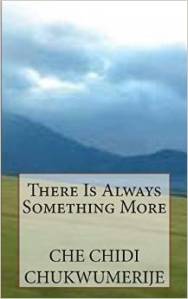
Taken from my collection of thoughts and stories: “There Is Always Something More.”