VARIETY

I don’t make Afro-pop
Or naija-hiphop
Everything I do is
Alternative

Oil is not the only source
Of Revenue.
Nigeria, diversify
Tap your other talents

Build planes
Phones triggered by thought
Find a unique solution
To the problem of soil Erosion

Restless creativity
Is the mirror altar of the Higher God
Don’t run from yourself
Be a native of your Inner voice

Celebrate the different bird
Celebrate the alternative curious thought
Celebrate the bold Spirit of adventure
Make the celebration of diversity your art and culture
in perception, in Expression, in creation.

– Che Chidi Chukwumerije.

BUHARI PUSHING THE BIAFRAN ISSUE INTO THE ONLY FIELD OF BATTLE HE UNDERSTANDS: MILITARY CONFLICT.

A soldier without a war must be a lonely man. So lonely that he feels no shame at taking military conflict into the towns, neighbourhoods, streets and homes of unarmed or poorly armed civilians of even his own supposed country just to assuage his thirst for blood and domination in the only language comprehensible to his one-dimensional soul. It matters not to him that the victims in question are civilians untrained in martial combat and lacking in the sophisticated weapons which he has purchased from foreign countries with the wealth of the very people against a section of whom he has now turned that same military machinery. While other great generals feel militarily fulfilled only when matched in even combat against a worthy and equally trained adversary, the small-minded blood-thirsty little soldier will leave real terrorists undefeated and, instead, withdraw his troops from true battle and send them into the homes of civilians, to intimidate, to brutalize, to maim and to kill, just in order to satisfy his desire for a sense of victory, however cheap and shameful.

And what is the crime of this brave civilian population in question, these Igbos? Only one: self-awareness. They committed the deep, unpardonable, human crime of becoming and articulating their awareness of their own self, their own individual nationality, their own distinct identity as a People. This crime, already problematic as it is on all continents, is most heavily frowned upon and most viciously punished, it seems, on the African continent. The very continent most desperately in need of internal soul-searching and honest appraisal of its own inherent primordial intuiting of what the root of a nation is and what the forms of nations are. The very continent whose peoples most desperately need to redefine all concepts of nationhood foisted on them by colonial intent and later further militarily appropriated by feudal desire. A continent that should today enrich mankind with new schools of thought in the field of the different possibilities for the expressions of human civilization. The very continent that, even generations later, most urgently finds itself still recurrently placed before the need to question the chains, the borders, the constitutions and the conflicts into which, partly splintered and partly moulded, it was birthed through the labour throes of a deliberate colonial curriculum. Yet, this continent is the very same one that most violently and most vehemently refuses to look at itself in the mirror and dialogue with itself as to the best way to create the political and policy spaces that most favour its multi-ethnic nature and further its development. Instead it fights tooth and nail to defend and preserve what other civilizations designed and then forced upon it, without permitting any investigation by its indigenes into how they themselves would have done it if no external force had foisted it on them.

And now it is Nigeria’s turn, on that troubled continent, to fall (again) into conflict with herself over this very issue: of sovereign African ethnic nations – of different languages, of different centres and concepts of power, and of different directions of loyalty – but forced into an artificially conceived and created country by profit-minded non-Africans; and which Africans have now since become no longer at ease as they perpetually run around an irreconcilable puzzle promised them by colonialism and inevitably overtaken by deep-rooted feudalism. The sense of a Non-fit keeps breaking out time and again, embodied in calls for self-determination or restructuring at the one pole, or even by extreme ethnic envies, marginalisation and blood-letting at the other extreme.

The spirit of Ala-Igbo has re-embodied itself, and the dawning recognition begins to settle in, that this is not a Biafran army that can be defeated in battle, or a state-land that can be appropriated by occupation, or an ethnic identity that can be obliterated by marginalisation, nor is it a tribe that can be cleansed by genocide. This is something else entirely. This is a spirit that no matter how many times you kill them, will NEVER GO AWAY. This is a People that has re-become self-aware, conscious of itself as a Unit, as a nation-continuum. This is a People who want Sovereignty in all its depths and ramifications. This is a People that have the clarity and sense of proud adulthood to yearn to be their own Nation, themselves! And if you must give them something else, it must be one in which they feel and know they are represented!

But Nigeria was conceived, and brought together, under the barrel of the gun. And Nigeria, finally, has continued to keep herself together, like a masochist, through the self-inflicted pressure and violence of a forced marriage. It is thus not surprising that Nigeria, bewildered and baffled, bemused, insulted and continually embarrassed by increasingly vitriolic and contentious calls for secession, for restructuring, for self-determination by separate ethnic regions – a natural manifestation of her inability to address and redress the clash of civilizations brought about by her unnatural birth – begins to react in the only way she knows: The way of violence, intimidation and coercion.

It thus becomes imperative for President Buhari, a former coup plotter, a former military head-of-state, a veteran of the genocidal 1967-70 Nigerian war against the Igbo people of Biafra, to concentrate his efforts now on militarising the current Biafran resurgence in order to create the sick impression of a pseudo-justification to send federal troops into the streets and homes of a section of the people, an ethnic group, the Igbos, who have hitherto not launched even ONE ATTACK on the military or on any other ethnic group; a people who’s sole call is for the permission to hold a Referendum on the issue of self-determination, but who now find themselves internally attacked and surrounded by the armed forces of the very country which claims that these same Igbos are a part of her. What an irony of machiavellian proportions!

The contention that a certain individual, Nnamdi Kanu, has been exceedingly vitriolic in his verbal agitations, is a shamelessly lame excuse for a military offensive against an entire ethnic region. All it shows is the inability of this administration, as indeed of the colonially born African complex – compounded by delusions of ethnic superiority – to address complex issues in anything but military and militaristic terms! This is a shame for Africa and the Black race, as well as a mark of dishonour upon every person who supports this military aggression against civilians. In the end, President Buhari remains still General Buhari, a military dictator who criminally uses the organs of State to persecute his opponents, rather than applying and following the rules of the path of judicial law. Africa returns to the past, and time stands still.

But much deeper than Nigeria is the Igbo Spirit! It is the ROOT. And if it ever needed further proof that it does not belong in this contraption called Nigeria, at least in its present form, it is being furnished this daily in these times. If it ever needed any proof that it will NEVER be snuffed out no matter how many times Biafra is beaten down, it is being birthed daily into this certainty in these times of modern pharaonic oppression to which it is being subjected in broad daylight! Buhari’s desperate attempt to militarize the eternal Igbo issue and the Biafran puzzle, apart from causing untold pain and hardship to many civilians, individuals, communities and families, only serves the purpose of further accelerating the Igbo soul’s abnegation of the Nation that repeatedly wages war against it! Ndi Igbo will stand together, will fall together, will rise together! Ndi Igbo can NEVER BE DEFEATED OR BROKEN!

Once upon a time, Sovereignty was brutally, cunningly and mockingly taken away from Sovereign African ethnic nationalities! In its place they were given arbitrary illogical amalgamations, full of culture clashes, and told that this is the way forward if they want to develop! In Nigeria’s case, this amalgamation – in order to survive – should have submitted itself, in Nigerian hands, to a process of positive metamorphosis that would eventually allow the reawakening and the harmonious, reciprocal and mutually supporting blossoming of that which was taken away: our sense of individual sovereignty as well as the substance of it. Instead it has birthed anomalies and monstrosities and exposed an inconvenient truth that just refuses to go away: African Tribes are the true African Nations. This was why, to place a fundamental impediment before their development, Colonial Design struck them at that core, to hamper the national self and create an illusionary centre that cannot hold. Don’t mind the lie. For, in truth, Igbo world and Bini world and Yoruba world and Ijaw world dwellt side by side for centuries, and got along – and so will their Nations too one day, if it ever comes to that. We know how to do it, when each person is allowed to be himself.

You cannot make Igbos into Nigerians by sending Nigerian soldiers into Ala-Igbo to surround them and occupy their land and forcefully force all of them to vote, and to forswear Biafra, and hail Nigeria, under the barrel of the gun! On the contrary – you thereby make them into non-Nigerians. Infact you cause them to retreat deeper into what they are – Ndi Igbo!

You cannot make Igbos want to be Nigerians by harassing them and brutalizing them and humiliating them and killing them with Nigerian soldiers and Nigerian might! On the contrary you strengthen them in their Sense of Self as Ndi-Igbo, for nothing binds together as tightly as shared persecution. You thereby simply midwife their determination to become one African Nation, either purely as Ala-Igbo or in the family ethnic groups of the Republic of Biafra, that survived persecution and learned and matured through its vicissitudes and mistakes, drew on its strengths, and made it alone into the First World!

You awaken their Inner Igbo Voice which will tell them loudly, proudly: “I AM IGBO! I AM SELF! I AM NATION!” – Maka onye kwe, chi ya e kwe!

IGBO KWENU!

– Che Chidi Chukwumerije

Background:
The president of Nigeria, Muhammadu Buhari, in September 2017, sent the Nation’s military into the south-eastern parts of the country where they tortured, humiliated and murdered citizens of largely the christian Igbo ethnic tribe, many of whom for decades have desired to break-away from Nigeria and establish their own country Biafra.

FOREVEREVERMORE

ONCE UPON a time in south-southern Nigeria, high up on the misty Obudu plateaux of those dreamy Sankwala mountain-ranges of which we only hear and read, but hardly ever see, there lived a voiceless girl called Iwi.

Iwi loved the air of the mountain-peak, she loved the clouds which sometimes came visiting, she loved the heavened birds that loved these same heights which she also loved; she loved the stars that shone brightly in the evenings, mornings and through the nights.

Iwi, being a little maiden, did not live alone. She lived with her mother, whom she called “Sister”, and who called her “Iwi, my friend”, for theirs was a deep and true friendship. Iwi’s father had also once lived with them and they had been a happy triangle. In those days her voice had still been with her, and her childlike songs and happy chatter had delighted her parent’s heart. Until one day her father died mysteriously, leaving Iwi and her mother to be each all the other had. The day her father died was the day Iwi lost her voice. As though he had taken it with her, try as she might, no sound ever again escaped her lips.

Iwi and her mother could have gone to live in any of the cities in the valleys where life would have been easier for them, but they loved these mountain-highs and preferred to live in hardship but preserve peace of soul. So up in the mountains they stayed, where they sensed their heart to be, and happiness kept them company every day. Together they reared the goats, tended the fowl, cultivated the farms and the gardens of those rare fruits that grew on those high climates, and rarely, but rarely, did they go down all the way to the valley, mainly to the Sankwala market, indeed just when they had to go.

As mysteriously as Iwi’s father had left the earth, her mother died one day, leaving Iwi now all alone upon their mountain home. If her father’s departure had taken her voice away, her mother’s did not bring it back, voiceless she remained.

After burying her mother, Iwi made the decision to continue to live up there where mountain-air, mountain-clouds and mountain-sighs gave back to her the love she gave. But lonely was she now, alone in the world, if we forget the the goats, the fowl and the flowers, and of course the fairies she saw not, although they saw her, and the friendy stars in the skies – all of which we may however not forget. Yet none of them proved able to restore to her her once beautiful voice.

She grew into a woman and grew used to being a single woman on the heights, managing and flowing, but once in a while longing for another human.

One day, like a miracle, who did she see walking there upon her mountains? A hermit, but younger than most hermits are, more handsome than hermits ought to be. If she was full surprised, then surely she was not half as surprised as he was… to find this beautiful woman living, alone, high up there where he’d come seeking solitude, hoping to discover himself in silence. So, shyly he avoided her for the next couple of months, and shyly she pretended too that he was not up there.

But then one morning, like a man must do, he waited for her outside her mountain hut. And when she emerged, he, in the Obanliku dialect of these parts, introduced himself to her and offered her a small basket of wild ụdara which he had gathered early that morning as the sun’s rays were still struggling to break through the mountain mist.

It is hard to say how long she stood there, silent, surprised, staring at him; but however long it was must have been of no consequence, for just as long did he too remain standing there, refusing to budge, waiting for her to reply. The moment was broken when, to her utmost shock, she heard her voice thanking him and then telling him her name. They both smiled as she accepted the basket of wild berries from him and then he turned around and walked away. And she had a voice again, awakened by love.

And so did they gradually they began to stop, to talk, one word here, two words there. And finally, over a year after he first arrived these heights, they began to live together. That he was a stranger to these parts was clear to her, for she heard it in his accent, although he bravely struggled to speak her thongue. It did not matter to her, it only made her love him all the more.

Love and understanding and joy are three things which when they arrive at the same time, in the same place, around the same people, create that thing which words cannot describe. And so it was between Iwi and the young hermit whose name, as he had told her that fateful morning, was Sike. Their love was eternal, immortal, intense – and it never ceased to startle them.

Through Iwi, Sike came to see and understand the Obudu mountains and their lush green forests with new eyes; its moods became a dictionary of new language upon his heart; mist or rain, animals or fauna, plauteaux or gorges, forests and waterfalls, his senses became born again to a world that was part of his native country but which he had never known, for it was so different from the world he came from that he knew he would never be able to describe it to the people of his world, villagers and city-people alike. And the more he discovered nature, the more he loved this beautiful female spirit who was the source of his rebirth. Everything that was special about this place was reflected in her nature – everything that was special about her personality was reflected in this cradle of nature. How could the one be separated from the other? The source of his joy became the emblem of his sorrow.

For just when Iwi came to believe that Sike would stay up here with her, forevermore, he told the truth about himself: he was a servant of his people who had come here to seek quietude and clarity, but had vowed to return to his people when he was done, to continue with his service. He spoke about communal clashes and border disputes, about social projects and missions of hope and other things he was not sure she understood. Without emotion Iwi listened to him and then, with trembling heart, waited for him to ask her if she would come with him, not knowing what her answer would be.

But the request never came. She did not ask him if there was someone else waiting for him in his old life, nor did he mention it.

Now Sike stood outside Iwi’s hut, looked at the sky, and tear on tear fell from his eyes. He’d come up here to find understandings rare, only to end up with much more than he had expected. After strengthening his heart with a silent prayer which Iwi did not see, but strongly felt, he turned to her and said:

“Iwi… I love you… eternally… but I love also the people I have pledged to serve, and I love the service I have vowed to fulfill all the days of life… they need me… and so I must return there where I came from.”

They held each other tightly one last time under the blue skies, tropical avians winging their way over, and he promised to love her… and she promised to love him… foreverevermore…

They parted on that same evening – Iwi remained with his heart upon her Obudu mounain-tops, Sike took her heart with him to his calling.

She never did find out to which constituency he belonged, he never came to know what became of her in the future; but every morning and every evening, both their heartborn, love-borne thoughts meet in the firmaments of Heaven, and their thoughts promise love foreverevermore.

– CHE CHIDI CHUKWUMERIJE.

Read other inspirational stories in:
THERE IS ALWAYS SOMETHING MORE.

———————————
———————————

NOTHING GOING ON BUT THE RENT

—-
A little familiarity with, even if not necessarily proficiency in, “nigerian english” might be necessary to understand this story. 🙂
—-
—-

My landlady was not a very bright person. Really, amongst all the stupid people I’ve met in my life, she must be the daftest of them all, or so it seemed to me at that moment. I stood behind her and saw the danger ahead. But this woman, instead of going left, she actually went right. Was she mad? OK, now that she had gone right, how did she expect to come out of this alive?

The truck was hurtling straight down upon her at blinding speed. Have you seen a speeding truck before? A monster, grim and merciless. The terror it awakens in the heart is raw, real, paralysing. You see death, literally. Death does not smile.

And into the path of this on-rushing death she stepped. Madam, you love death? Then, so be it! But then not even I am so cold-hearted, in spite of all the horrible things this terrible woman had wrought upon innocent me in the past. It would be good to save her life, to spare myself any future battles with my talkative conscience, and to put her in my debt also.

The slap I gave her sounded like a ringing bell proclaiming victory. I relished the slap thoroughly, my palm jubilated, the woman took off like Arik and flew to the left, out of the path of the on-rushing accident. As she went air-borne, she took me along with her, for my palm was still stuck to the side of her face. We crash-landed into safety on the sidewalk and I disengaged my jubilating palm from her warm oily face. The truck roared past. I had just saved a human being’s life.

Life. Is that not what it’s all about? You would have thought that she would be grateful. No, instead she took offence at the joy of my palm.

“Heei!” she shouted, “this my tenant want kill me oh!”

The word ‘kill’ is the code word. And the speed with which the crowd gathered showed practice in such matters. This is the land of jungle justice, staccato accusation and swift execution. Death, who had formerly been sitting on top of the truck, glaring at her as the truck rushed towards her, had now hopped down from the truck which had long disappeared into the wilderness of Ikorodu Road. Now Death sat cross-legged by my side, betwixt the crowd, and stared at me accusingly as if I had ever done anything against him in my life. The thought suddenly occurred to me that he might be upset with me for not having let the truck do his will.

Before I knew it, the crowd had pulled the woman, my landlady, up and I was still lying there, feeling the jubilation in my palm tingle away. The crowd crowded itself around me like a crowd. It was crowdy. From crowdy comes, rightly, rowdy.

“Hired Killer!” a strange voice, full of mortification and aggression, barked down at me.

“Eh?!?!” screamed the crowd and instinctively drew back one step. If I had been been Ben Bruce and in possession of any common sense, that’s when I should have made a dash for it – bolted away with the full spring and speed of all my unreduced athleticism, in that moment when the fear of a hired killer in flesh and blood in their immediate vicinity paralyzed the life out of them.

But I was distracted by Death. He was still sitting, cross-legged, there in front of me. As if he sensed the quick escape plan that darted into my mind, he scowled and gave me a very threatening look. If you dare try it…!

And in the moment of my preoccupation with Death’s awful mug, the very moment was gone. I did not see the first slap, I did not feel the first slap. Curiously, I heard it. It sounded like a whistle, but I’m not quite sure exactly what kind of whistle. A slap whistle. A whistling slap. In one register it vibrates the eardrum already one micro-moment before impact. You hear it once and then you hear no more. The first becomes the last.

I was confused. Is this what they call a mobbing? After I stopped hearing, I started seeing. Stars. They kept exploding. Why did they keep springing from place to place instead of just hanging still? That was when the pain kicked in. And not just literally. I don’t know why the government, who likes to ban rice and all sorts of other things, has not yet banned the importation of boots. Because the kick to my ribs, the kick that brought back the consciousness which the sonic slap had robbed me of, the kick with which the pain kicked in, the kick that returned to me my hearing, that kick was executed surely by a foot well lodged in a boot, a big strong boot, definitely imported, made I am sure in Russia or Germany.

“Yeeeeiiii!” I screamed, “I don die oh!”

I could not see the sun; dark shapes hovered all around me, hurting me, harming me. Why? And then I heard the dreaded words:

“Tire!”

“Fire!”

“Tire!”

“Fire!”

They were going to put a de-rimmed rubber car tyre around my neck, drench tyre and me in petrol, juice of the Delta, and burn me alive! My teeth went cold.

“Fire!”

“Tire!”

“Fire!”

“Tire!”

I looked to my right, to where Death was sitting down cross-legged, overseeing my extraction from the physical cloak. There was a peacefulness about his countenance that flowed over to me, into me, infected and affected me, a peacefulness that began to creep into my soul.

I seemed to hear a soft slow voice somewhere in the hall of my mind: Don’t struggle… don’t worry… it’s just a journey…

At that moment the tension slipped away from my body, my dogged determination to cling unto life was knocked out of me, aided by a rock, a rock it must have been, felt at least like a rock to the skull. A liquid running down my face, stinging my eyes, blinding me. Warm sweet blood on my tongue. An intimate smell. My blood. So this is how it feels to die.

That was when I heard her voice again, the voice that triggered this happening, bringing it now to its banal conclusion. The first again the last. My landlady was shouting again.

“Abeg, e don do oh! Thank you! My tenant don enter my trap today. Make una call police to arrest am, dem know what to do. Make una no kill am oh! HE NEVER PAY ME MY RENT FINISH!! My rent oh! Make una leave my tenant for me oh! See me oh. Leave my tenant! Abi, who go come pay me my remaining rent money now? Ah ah! I say leave am! Una dey craze? One year’s rent. See my wahala oh. Who send una sef? Busy body! Na so so busy body just full dis Lagos sef! Mchw! I go wound una oh. Ah ah! Police yee! Wey police now?! Which kind bad luck be dis?…”

**********

– che chidi chukwumerije.

**********

SOMETHING’S MISSING

I don’t know if you’ve heard
There is a land where girls were stolen
Kidnapped it’s called in sociopolitical speak

That land happens to be my country
Those girls another set of casualties
In a war of religion and education

Let’s just call it a war on humanity
The candles are going out
From one country to the next

Some swear the second world war is not yet over
Others boast the cold war is far from done
Meanwhile an old war has long begun

Some call this the third world war
The last one apparently Nostradamus encrypted
For sure it is a religious war on faith

Everyday it opens up a new field of battle
Now it has picked on my country too
And made her the new local theater of a global scourge

But how do you win a religious war?
By killing, or by forgiving?
By retaliating or by reconciling?

It is a philoshical puzzle
A paradox of semantics
In which real people die everyday.

– Che Chidi Chukwumerije.

THE POWER HUNGER GAMES

If I don’t win these elections
I will burn down this country

Well I think if you win
You will burn it down even faster

Some people don’t shout any more
They let the bombs speak for them
Some people don’t threaten any more
They let the kidnapped girls be their message

These are those days again
When fear paralyses the strong
And empowers the weak.

And then they won
And it was business as usual
As usual.
Fool us twice, shame on us.

– Che Chidi Chukwumerije.

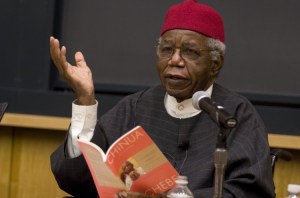
CHINUA ACHEBE: THE MAN WHO CHANGED THE CONTEXT OF THE CONVERSATION

image
“If you don’t like someone’s story, write your own.”
– Chinua Achebe.

When you see a well-cleared road through the jungle, it is sometimes hard to imagine that once upon a time there was no road there, only trees and bush. To put it differently, when you see a jungle in front of you, it is sometimes hard to see a road whose past was a jungle. So stoic and self-justifying in its impenetrability that it would never have occurred to anybody that this jungle has no right to block our path; that anywhere we say “Let there be road”, there will be road; that it is not for the jungle to blind us to our possibilities, but for us to open the jungle up to our needs; that we have the right and the ability to choose and determine the range of our options by ourselves; that it is not the task of roadlessness to indoctrinate us from birth into the stupor of its own inevitability, but for us to be immune to the concept of “roadlessness”, and learn to see the obvious: it is man that defines himself.

But once in a while, a person comes alone, a special mind of deep intuition struck by an unaccountable thought. What if I am not who they say I am? What if I am something else? What if this jungle is not what we assume it is? What if it is a road dressed up with trees? What if that “mirror” they’ve placed in front of me is not a mirror, but a painting of what they want me to think I am? What if I now make my own mirror, with which my kind and I can see ourselves as we really are – what would I then see? What if the freedom they’ve given me is in truth a mental prison? What if the education they’ve brought to me is in truth a software of mind-control? What if?…

Once in a while, a person wakes up because the “What if?” moment has taken root in his consciousness. And, like a mustard seed, the “What if?” question will mature into a “Yes, indeed” answer in this person’s mind. And this person will become a leader. This person will part the red sea of somnambulism. This person will turn the mirror around. This person will change the context of the conversation. This man will open a road where others saw an impenetrable jungle. This person will rid the obvious of its garb of concealment, allowing it to arise in all its naturalness and normalcy, so intoxicatingly immediate, this simple truth: we are not who they say we are, we are who we know we are.

Pioneers and groundbreakers like this are very rare and far-between. But every once in a while, they step on the stage, to nudge the development of a people’s consciousness one step forward, creating new inner living spaces for the growth and flourishing of generations of consciousness.

Such a person is Chinua Achebe.

Many things fell apart when his first novel appeared; above all, the tight bind of redefinition wrapped around the thinking and perceiving faculty of the average colonised and educated African. It began to unravel, spearheading in its wake a generational surge for self-re-redefinition that did not stop with the generations that midwifed its birth, but has transplanted itself from generation to generation. Like every unravelling, it has been untidy. We know what we were. And we know what we aren’t. Armed with these pieces of the puzzle, we struggle to attain the living definition of the question: Who are we? A journey buffeted by the twin helpers of self-pride and self-criticism as we travel on along that road cleared through the jungle by vanguards such as the late and forever unforgotten Chinua Achebe.

– Che Chidi Chukwumerije.

FROM INDEPENDENCE TO SELF-DEPENDENCE

The news around town is that another Nigerian is claiming to have found a cure for AIDS. Again. Social media shakes its head and reminds us of Dr. Abalaka. Lone voices call for more funding, more testing. Experts take a strong look and immediately distance themselves from him. A few days later, he recants and apologises for making public something still in its early phases, according to him. Everybody breathes out; one almost wonders if we’re relieved that pseudo-normalcy has been restored:  Nigerians, indeed Africans, don’t discover or invent anything noteworthy. There is always something more to the story.

But what is actually the essential thing here? As unfortunate as it is that this fiasco played itself out around something as sensitive as this death-dealing virus, it inadvertently brings to light another matter at the core of our continental drift. Be it in medicine, in technology or in any other field necessary for the structural upbuilding of nations. Very simple: how long will we remain dependent on the solution-finding endeavours of others? I thought Independence had another meaning. But since it seems Independence, as a word and a concept, has over the last five decades of Africa’s ‘independence’ surrendered itself to another definition – one that includes inefficiency, beggarliness, corruption, division, non-productivity, squandermania, boastful pride and retrogression – and thereby lost its function as a star drawing our feet forward and a compass showing the way, it has maybe become necessary to temporarily park that word – Independence – in the purifying purgatory of history and replace it with a new-crafted word that more unceremoniously exposes the well-camouflaged wound and slams the nail on the head. A term devoid of poetry and romance, simply being stable and as unmistakably understandable as black-and-white.

A word that very clearly states, describes and defines what we did not get in 1960 when we became independent; nor in 1963 when we became a republic; nor in 1970 when we got the task done of keeping Nigeria one; nor in 1979 when we returned to democracy, new constitution in hand; nor through decades of near-uninterrupted military rule; nor have we found or got it since 1999 when we AGAIN returned to democracy, remixed military constitution again in hand; and even until today we still have not got it. Let us call this word: SELF-DEPENDENCE.

It is the perennial bane of Africa, a continent of people who claim to be the birthpoint of humanity, of civilization and of technology that every modern contraption of essential value which is required for its growth in a modern world, is invented and made on other continents and then freighted into the cradle of civilization at high prices or – even worse – as donations. How many times have we heard the lectures about the great people who built pyramids on the banks of the Nile and then migrated to the banks of the Niger, by which time they had apparently forgotten how to build pyramids because here they started to build huts? Or of the great empire-builders of Mali and Zimbabwe whose descendants, perhaps patronized by the mental version of the tse-tse, steadily slumped into the generational amnesia that rendered them incapable of matching, talk less of outdoing, their forebears?

Truth be told, such tales bore the tears out of me. I’m more interested in other, more recent, exploits, uncelebrated and often greeted with perfunctory yawns of tired amusement at best; but even more often with suspicion, ridicule and denunciation. A tinkering family member of mine and his colleagues designed some new technical thing – don’t ask me what, all I know is that it has to do with computers – but they went ahead and patented it; now some firms want it – apparently it’s the solution they’ve long been looking for. My former secondary school classmate developed with his team a breakthrough procedure for extracting the cells that make up the blood-nerve barrier (if you’re confused, don’t worry, so am I), but it permits an important step forward in understanding peripheral neuropathies, which affects millions of people worldwide.

Some months ago I read of some tenacious eccentric young man in Kaduna State, in northern Nigeria, who has been trying to build a rocket since he was a kid. His last effort did not fly very far, but it flew. The news gave me a thrill. My friend from the south did not know exactly what to make of that piece of news, cautiously asking me in which cardinal direction I thought Boko Haram would first direct that rocket if after the young man ever perfected it, BH stepped in and confiscated it. My answer: don’t worry about that – once one African builds a rocket, another will soon build a magnetic return-to-sender shield. The thirst to invent and build just has to be set free first of all, and encouraged and supported – morally, culturally and financially.

A few years ago I read the amused article of a journalist reporting on another young man, this time in Onitsha in eastern Nigeria, who had designed and built his own version of a helicopter. The writer wondered who would be the first daredevil to attempt a test-flight. And then it was on facebook not long ago that the link to an article was doing the rounds, a report on the scientific tinkering of some secondary school girls in Lagos, in western Nigeria, who had tinkered an electricity generator powered, not by the black curse called petroleum fuel, but by urine. (You read that right). Let’s not go into the jokes people cracked about that. The generator worked, by the way. If you understand anything about the mysterious fuel cabal in Nigeria, you’ll know why this news might cause some powerful people sleepless nights and blocked urethrae.

Tell me more of these stories – these are the ones I like to hear. Why? Simple. How long will we fill our lazy stomachs with the swelling garri of empty pride, back-dated? Must every good thing exist only in some distant dusty past painstakingly reconstructed by dogged historians? What of the future? Who designs it? We don’t need to re-invent the past; we simply have to invent the future. Now, the reason why we should do this, surprisingly enough to the unbelieving, is not even pride. It is more practical than that. It is economic. (The economy, stupid 🙂 ). Long-term sound economics. What is at the core of that which makes a 1st world country a 1st world country? Not the appellage, not the climate, not money, not weapons… but simply the power and the ability to INVENT. The urge as well as the consciousness of the necessity, constantly put into deed, to create new things, to find new self-made solutions, to imagine and anticipate future problems, to constantly improve anything that exists, be it a substance or a process.

If you cannot figure out anything by yourself, you will never be self-dependent and you will never be free, because you will always be dependent on those who do the figuring out and the making. If you cannot make anything by yourself – not just what you yourself need, which in itself would already be a giant step towards self-dependence, but also what others need – you will never be truly independent, because your so-called independence will lack the fortifying ramparts of self-dependence. Every shift in technology is a potential threat to your future stability. You remain constantly one step away from becoming a colony anew. Laugh not at those who warn about neo-colonialism. Political and military independence can be safeguarded long term only by economic self-dependence. And economic self-dependence exists truly only to the extent to which the basis of a people’s, a nation’s or a region’s wealth rests to a large degree on its own capacity for industrial and technological creation. Wealth that comes from the monetary equivalent of fossil fuels stored in the ground by nature’s forces is not real wealth. Real wealth is generated by the power to create or to make (out of something or even out of apparently nothing), to make a needed end-product. Some people call it the power of ideas. I think it’s more than that – we all have ideas. I think it’s the culture of industrial creation; making new things and making things new. Don’t buy everything, build some. Don’t take it, think it.

This is where we have so sorely lagged behind in Sub-Sahara Africa for much too many centuries now. There is no satisfactory excuse for this. We cannot blame others for not giving us the education on time, or in sufficient depth, or spreading it around generously enough without tempering it due to ulterior motives and all the rest of that dialectic, because well they pieced it together and systemized it by themselves, or at least preserved and built upon the documentation and further development of it. We could have also done the same for ourselves over the centuries. All kinds of ethnological theories abound as to why the different continents developed as they did. Well, let bygones be bygones, we are not time-travellers. The moment is now.

Now that we have the knowledge today, why are we still importing the application of it? What will we do when technology shifts away from fossil relics and we no longer have their monetary equivalent with which to pay for the import of new applied intelligence? Is that when we will start trying to learn how to use our own intelligence? Or will we go borrowing from IMF and World Bank? Maybe ‘Independence’ is a pun for a state of living “in dependence”. We need inventors, discoverers and makers, for whatever they imagine and create – or omit to imagine and create – today, is our future tomorrow. We need inventors. Or, to put it differently, we need to identify and, as a matter of public and private policy, indeed as a matter of culture, support our individual inventors specifically and the spirit of invention generally. Institutionalize it even. The cultivation of ideas, the inventing of models, the indigenisation of industry, the manufacture of hardware, the innovation of standards, all this should become a part of our culture.  Put on your time-telescope and peer far into the distance of development: you will see that there is no other road that leads from 3rd World to 1st World.

If there be any Nigerian, indeed any African, in whom the spark of invention, the light of discovery, the visionary eye that sees the future’s questions and answers, the power of innovation and the hunger for creation dwells, then the New African Consciousness must recognise in such a person a rung on the ladder that leads out of the dungeons of dependence. You can only be a part of those who dictate things in the new world if you were one of those who invented and designed that new world.  To set our policy-compass towards the attainment of self-dependence, but also to properly understand the source and anchor of concrete self-dependence in a world increasingly run by the power of ideas, constantly churned into an unending cycle of research and development, this is the nature of the new struggle. The spark of genius rests in the fertile soil of even the most simple mind. Parents, guardians and teachers: encourage your children and wards to join this struggle. Leaders, encourage your people to join this struggle. It is the struggle for self-dependence. Aluta continua.

Once we fought externally for independence. And, according to our definition of it, we got it. But we forgot to also fight internally for self-dependence. Simply put: we became independent, but we never became self-dependent. And it is just like freedom – if you don’t fight for it, you won’t get it. In other words, you cannot get what you have not fought for. You cannot defeat an enemy you have not properly identified. The journey did not end in 1960; it continued: the journey from independence to self-dependence. For what is independence without self-dependence? Nothing. Unsustainable.

And OK, I admit I lied; it’s not just about economics. It’s also a bit about pride. The kind of pride I sensed in a reporter of African descent who I saw on TV not long ago happily interviewing a group of Ugandan university students who had built a functional, beautiful, mobile, modern electric car. The best part was when he asked them why they chose to build an electric car instead of a petrol or diesel engine car. They said, because electric cars are the future. No point building the past.

– Che Chidi Chukwumerije.

CHRISTMAS ON GRAILLAND

Ibises of paradise
Crows of light
Echoes of Dove and Rose
Palm Trees and Christmas Day

From high up on a Tower
Bells ringing
Come to rest…
And the rest is Christmas Day

Side by side
We shoulder the walk up
The Mountainstar, unto the
Mountaintop

And peace.
For we are not walking alone
We are walking alone
With nature’s laws.

– Che Chidi Chukwumerije.

ELOKA

image

AFTER THE NIGERIAN Civil War, popularly known as the Biafran War, Eloka could not find his feet anymore. He had run away from home and bluffed his way to the front where he miraculously survived. By the time the war ended however he had learnt all those slippery gripping things which are most dangerous to learn in those teenage years.

A drug addict, possessed of fits of violence and passion, and unable to focus his attention on anything serious for any considerable length of time, he became in the post-war years a source of sorrow and heart-ache to his parents and family. He was the fifth and youngest child of his parents, their baby and most beloved. His mother shed innumerable tears. His proud and stately but gentle father, a high chief of their people, bore it with a grim silence.

And then, somehow, someone hit upon the disastrous idea of sending young Eloka to America; for some reason they indulged in the logic that, at school there, far away from home, Eloka would be moulded into a man, forced to become self-controlled, responsible and mature. – And so, off he went to America.

But even many a stable and level-headed adult has been turned and broken by America, that distant continent, not to talk of this unsettled youth. Reports have it that he indeed at first attended his courses at the university, but with time Eloka gradually eased away from contact and eventually disappeared from sight.

Full of concern and agony, in which was mingled a stab of self-blame, Chief Ogbonna – Eloka’s stately father – contacted all known relatives and friends in that giant continent-of-a-country, pleading with them to help find his Eloka. But look high or look low as these people did – even with the help of police and private detectives – Eloka was nowhere to be found.

Sorrowfully his parents resigned themselves to the certainty that death must have overtaken him. Eloka’s war-torn nature, they lamented, had broken out again and done him in. Oh… that war! – Eloka’s mother’s tears flowed again, night after night, as she called his name into the unresponsive wind. And Eloka’s father again bore these times with a leaden heart of silence.

But then, as life always shows itself to be running differently from what we think it is, Eloka suddenly appeared again, not in America, but back in Nigeria. But when Chief Ogbonna gazed into his son’s eyes he saw, not the son he once knew, but a harassed stranger. And the Chief openly shed tears. And whilst others thought they were tears of joy, in truth they were tears of pain and loss. Now he really knew that his son was gone from him for good.

The others, however, only celebrated his return. His mother, though she sensed the absolute change in him, refused to acknowledge it as she clung unto her love for her returned son, and proceeded to go through the motions of being a happy mother.

But, truly, nobody knew the real reason why Eloka had suddenly and miraculously returned. He had simply been on the run from other gangsters who were after his life, and had fled to his native country to wait out the heat.

The heat did cool off, as Eloka established through telephone conversations, and then, just the same way as he had returned, Eloka whisked himself back to America.

Let me not disclose the renewed sorrow that descended upon the Ogbonna family. The years went by. For a long while nobody heard anything from or about Eloka. But then, slowly, pieces of news about him began to painfully filter through: wanted by the police here, fleeing from the law there, etcetera.

To say that all this added to the quickened deterioration of Chief Ogbonna’s health would be an understatement. Slowly he withered mortally away…

Meanwhile, on that strange distant American continent, Eloka began to slowly come to a better understanding of life and himself. The works of great philosophers slid through his fingers and across the canvas of his soul and he discovered his buried I. He began to study and to read and to think. Reading wrought a strange change upon his spirit and suddenly, as though with new eyes, looking about him he found himself surrounded by works and people that had the capacity to inspire him, and all of a sudden the country seemed like a whole different place – a land of opportunity. And then he began to think about his life.

It became clear to him that he had nigh on senselessly wasted over two decades of his life being less than he could be, less than his parents had brought him up to be, less than his father had all along been waiting for him to become. His father. His mentor. His childhood hero. He remembered the gulf that had yawned between both of them when he last saw him that time he fled home fifteen years earlier. Remorse gradually took hold of him and the urge to close this gap that had opened up between his father and himself.

To this purpose at the age of forty, Eloka’s life began anew. He turned away fully from crime and, over the next couple of years, settled his cases with the law, left the bars permanently behind and eventually worked himself into a job as a writer of newspaper articles. He wanted to step before his father as a respectable and capable son. – Once or twice he considered writing a letter home, but never did so.

But this period of transformation had not yet ended when the heavy, fateful news suddenly and abruptly filtered through to Eloka that his father had just died after a protracted bout of illness. A wild pain, laced by regret, tore through Eloka. Suddenly his life lost whatever meaning it had recently and newly found again. His only star, only beckoning light, was gone. What was he to do now? Could anything be done? Eloka was tired. For although he dearly loved his mother, his brothers and his sisters, it was his father who had always been the owner of the deepest love in his heart.

Yet why did he not even now return home? Or communicate, or something, anything, to make the pain in his heart, and in everybody else’s too, go away a little. – But, no. His life was empty now, his destiny altered. There was nothing more to strive for… – wispy thoughts that stung at night.

Yet must credit be given to Eloka however. He did not revert back to crime, nor did he ever contemplate suicide. He simply drifted on in that old new world and completely forgot his old homeland, a stranger in a land of seekers and dreamers.

Unknown to Eloka however his father was still alive and, in fact, hale and hearty. Chief Ogbonna was not dead., neither was his mother. It had been a case of misinformation, accidentally or deliberately. Both his parents lived, resigned to their loss and newly resolved to making the best of the rest of their lives. In this spirit, the Chief had kicked against the dejection that had been slowly killing him, and returned to life.

They lived over ten more happy years together and then the old Chief, in his nineties, was the first to close his eyes to a rich and many-sided earthlife. And, in accordance with the customs of his people, an Igbo village in Eastern Nigeria, though his body was interred immediately, the public funeral ceremony was fixed for a distant month.

Hardly had his body been buried, however, than private investigators in America, constantly hired over the decades to seek out Eloka, found him at last. They communicated this piece of news to other relatives of his who also lived in America and these set out to meet him.

Great, and not to be fastened in words, were the emotions that suddenly surged up in and overwhelmed Eloka when he opened the door of his apartment and gazed into familiar, long unseen, loved faces, gazing back at him.

Tenderly, ever so tenderly, they broke the news to him about the recent death of his beloved father, Chief Obinna Ogbonna. But they did not know the reason why Eloka sat so still after hearing this strange, startling piece of news. Eloka was dumbfounded, perplexed, thunderstruck, silent. Very silent and very still. But his soul was in tumult.

The realization that his father had not died over ten years ago like he had heard, like he had all the while thought, but had been alive all this time! All these years, years in which he, Eloka, had finally, even if almost nonchalantly, achieved that which only the longing to meet his father again had awakened in his heart some fifteen years ago now. To be a respectable son and capable, independent, balanced man. Years in which he could have visited the old man as often as he pleased. Ten years. All gone. For he had believed his father dead all along. Now history.

Why had fate misinformed him years ago? But whose fate? And who’s fate?

Eloka’s thoughts floated back to his childhood, to the time before the war, before that haunting turning point. How many evenings had he lain beside his father, listening to his breathing? During how many meals had he sat by the loving man’s side, pilfering solemnly slices of fish and roasted chicken from his plate? How many times had his father tickled him, made him laugh and then made him proud with tales of their ancestors, and then made his heart tremble by telling him how eager he was to see what his boy would be when he became a man. How many times had he longed again and again for his father, his father for him?…

And so, Eloka, now in his mid-fifties, who did not visit his father while the man yet lived, and longed, boarded an American plane in that distant month to go and visit him at his funeral.

– Che Chidi Chukwumerije.
 

image: 3345408/pixabay