METAMORPHOSIS

THERE ONCE lived a girl called Vanity. It was in that strange country where newborn babies are left unnamed – simply being referred to as so and so’s first son, so and so’s third daughter, etc – until they have grown into childhood. Only then would their parents and relatives, having up to this time carefully studied the character (for early dawns day) of the one to be named – finally confer upon the child that name which they believed best captured the essence of its core personality.

And so did this girl, from an early age, come to be called Vanity, for she was as proud and vainglorious as a peacock. Vanity believed that the whole world was there just to serve and admire her. She did not care much for others, nor could she tolerate, in her vicinity, another receiving more attention, admiration and adoration than herself. This she simply could not bear. She thus constantly went to all and any lengths to make sure that the attention of everybody would always and only be riveted upon only her. Vanity dressed in the most beautiful of clothes, wore the most attractive ornaments, learned the most alluring manners of self-expression, perfected the most sensational methods of walking and swinging, and – being the scion of wealthy royalty – made it very obvious to the gentry that she had a lot of wealth to spread around. The inevitable consequence of this was that the world divided itself into two groups before her – those who crowded themselves around her and those who avoided her. Great was her pleasure, for ‘her side’ verily outnumbered the other side.

As she grew into a teenage adolescent, a spectacular beauty happened to grow out upon Vanity’s features and fitted itself around her form. Naturally this pleased Vanity extremely  and only served to confirm for her and her court her egotistical claim to prenatal supremacy. And at this point her name changed spontaneously from Vanity to Beauty. Beauty became the rave of her time, the talk of town, the object of the envy and idolisation of the women, the desire of the men – exactly what she wanted. Beauty wore her outward beauty like a trophy and used it ruthlessly to acquire everything she wanted, most of which she indeed also got. For people practically worshipped Beauty; they made her their idol, their goddess, their queen. She controlled all.

Such was it that by the time she had become a young woman her name had changed once more – and now everybody called her Power. Power exalted in this name granted to her by her fellow human beings and proceeded to have a crown manufactured for herself on which her name was inscribed for all to see. She became so full of herself that there was no space left for her in which she could continue to expand, nor could her bloated ego grow any further. It neared its peak, its limits. Her ways became stiff and cold, lifeless. She could not find any further height to reach and claim. She became an ornament herself.

And very soon her name became Rigidity. For rigidly fixed was she to the dogged attachment to vanity, beauty and power. She bore no love for other human beings. Frightening and strange became her ways. Rigidity detested her new name intensely and tried to rigidly hold on to the previous one and to thus force the people to keep on calling her by it, but the people, like people like to do, persisted in calling Rigidity by the newest name they had given to her. And the harder she resisted it, the louder they called it.

It happened that, at this time, owing to her persistent attachment to old forms, her health broke down. By the time she recovered, her face, older, less beautiful, remained marked by the deep scars of her illness and struggles, and there was a tired ring to her voice. And, for some unknown reason, the people at this point began to call her Lesson. They pointed at her and said: “Lesson, Lesson, Lesson!” And Lesson saw that they were but pointing her out to the new, young beauty in town and pointing out her own destiny to her too. Lesson was very dejected. Sadly she sneaked out of town in the dead of night and wandered lost and lonely, trying to put a finger on what exactly had gone wrong in her life. And Lesson spent many years trying to understand life. Many lonely years.

And during these years of her travels, fellow wayfarers who saw her simply dubbed her with the name Simplicity, for she walked silent and alone and appeared to do all her things simply. When Simplicity found out that this was her new name, it seemed to her that there was a hidden message and clue in this name. She then began to consciously strive to do all things simply, to think simply and to cultivate true simplicity of the soul. Finally Simplicity settled down in a little hut in a little village where she cultivated farms and gardens and grew to love children and nature.

The people of the village loved exceedingly this obviously aristocratic yet so modest, archaic stranger who had come to live amongst them and, inspired by her ways, they named her Humility. This name struck the surprised Humility with such great humbleness that she again, using it as a guiding star, started striving consciously after true humbleness and humility in her life, in order to become worthy of the name. Humility was ever ready to carry out even the lowliest of tasks and was never too proud to speak up for the truth when she saw it being denied, or even to fight for it, no matter how much of a fool she might appear in the eyes of others for doing so; for in her newfound humility it no longer mattered to her what others thought of her. Because true humility is strength, not weakness, as we all know.

The people of the village learnt much from Humility, who was by now rather an old woman, and gradually they recognised the absolute magnificence of the beautiful female spirit that occupied her old body – which revealed to them the essence of true inner beauty – and, unanimously, they agreed to change her name to Beauty! And so, for the second time in her life, Beauty was called Beauty again, but now for a genuine reason, for the truest of beauty is the beauty of the heart.

Many more years has Beauty now lived amongst the people of this dear and beautiful village, and it is Beauty herself who is now writing down her own long and eventful story. Except that now – now that this village has become a place of that true heavenlike peace and beauty which she has always borne hidden, deep, within her maturing soul – Beauty’s name is no longer Beauty, but she now bears an other and final name which will be the one that will be etched unto her grave tablet when this old, warm body of hers is finally returned to earth. And what do you think this her ninth name is? – It might be Service; or Leadership; or Strength; it could be Love; or perhaps Peace; or even Heaven. It may also be Purity; or Guide; or Guardian; or maybe it could be Mirror. Choose for yourself, every woman out there, do.

I am simply what I should be.

Emptiness always makes the greatest noise. Would that emptiness could learn to become silent, that it may be true and become filled.

Goodbye, Earth. – – –

The beautiful old woman died two days after writing down her own story; and when she was buried, the grateful village people inscribed upon her grave stone the single word…:

HOME.

– Che Chidi Chukwumerije (from my collection of short and inspiring stories and essays titled „There Is Always Something More“)
Available on all Amazon stores.
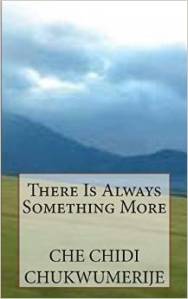
amazon cover copy there is always something more 2015

OVER THE MOUNTAINS

Deep music is sailing over the mountains and into the hearts of lonely people far away. Over the mountains – over the mountains – the sight is glorious and gone. Much is gone that was here yesterday. I feel like an old man, waiting to die. But, rather than wait, why don’t I just spread my wings and fly again, like I did when I was young.

The earth is not my home. The earth is not my home, but my way home. Over the mountains, over the mountains, all is happy. It came and went so quickly. But I do not mind. Because what joy did not finish, pain shall. And vice versa.

– Che Chidi Chukwumerije.

CLOSURE

They say a time will come
When upon this earth
Evolution will girdle its gains
Back again around its girth

Many a wondrous tree
That we cherish and deeply love
Will, year by year, with time
Evolving slow dissolve

Many a beloved animal
Continents, rivers, plateaux
Even man, the so-called crown
Yes, our body too will go

And one day, even she
Heaven’s gate and heaven’s door
The lovely lovely rose
On earth will be no more.

– Che Chidi Chukwumerije.

ELOKA

image

AFTER THE NIGERIAN Civil War, popularly known as the Biafran War, Eloka could not find his feet anymore. He had run away from home and bluffed his way to the front where he miraculously survived. By the time the war ended however he had learnt all those slippery gripping things which are most dangerous to learn in those teenage years.

A drug addict, possessed of fits of violence and passion, and unable to focus his attention on anything serious for any considerable length of time, he became in the post-war years a source of sorrow and heart-ache to his parents and family. He was the fifth and youngest child of his parents, their baby and most beloved. His mother shed innumerable tears. His proud and stately but gentle father, a high chief of their people, bore it with a grim silence.

And then, somehow, someone hit upon the disastrous idea of sending young Eloka to America; for some reason they indulged in the logic that, at school there, far away from home, Eloka would be moulded into a man, forced to become self-controlled, responsible and mature. – And so, off he went to America.

But even many a stable and level-headed adult has been turned and broken by America, that distant continent, not to talk of this unsettled youth. Reports have it that he indeed at first attended his courses at the university, but with time Eloka gradually eased away from contact and eventually disappeared from sight.

Full of concern and agony, in which was mingled a stab of self-blame, Chief Ogbonna – Eloka’s stately father – contacted all known relatives and friends in that giant continent-of-a-country, pleading with them to help find his Eloka. But look high or look low as these people did – even with the help of police and private detectives – Eloka was nowhere to be found.

Sorrowfully his parents resigned themselves to the certainty that death must have overtaken him. Eloka’s war-torn nature, they lamented, had broken out again and done him in. Oh… that war! – Eloka’s mother’s tears flowed again, night after night, as she called his name into the unresponsive wind. And Eloka’s father again bore these times with a leaden heart of silence.

But then, as life always shows itself to be running differently from what we think it is, Eloka suddenly appeared again, not in America, but back in Nigeria. But when Chief Ogbonna gazed into his son’s eyes he saw, not the son he once knew, but a harassed stranger. And the Chief openly shed tears. And whilst others thought they were tears of joy, in truth they were tears of pain and loss. Now he really knew that his son was gone from him for good.

The others, however, only celebrated his return. His mother, though she sensed the absolute change in him, refused to acknowledge it as she clung unto her love for her returned son, and proceeded to go through the motions of being a happy mother.

But, truly, nobody knew the real reason why Eloka had suddenly and miraculously returned. He had simply been on the run from other gangsters who were after his life, and had fled to his native country to wait out the heat.

The heat did cool off, as Eloka established through telephone conversations, and then, just the same way as he had returned, Eloka whisked himself back to America.

Let me not disclose the renewed sorrow that descended upon the Ogbonna family. The years went by. For a long while nobody heard anything from or about Eloka. But then, slowly, pieces of news about him began to painfully filter through: wanted by the police here, fleeing from the law there, etcetera.

To say that all this added to the quickened deterioration of Chief Ogbonna’s health would be an understatement. Slowly he withered mortally away…

Meanwhile, on that strange distant American continent, Eloka began to slowly come to a better understanding of life and himself. The works of great philosophers slid through his fingers and across the canvas of his soul and he discovered his buried I. He began to study and to read and to think. Reading wrought a strange change upon his spirit and suddenly, as though with new eyes, looking about him he found himself surrounded by works and people that had the capacity to inspire him, and all of a sudden the country seemed like a whole different place – a land of opportunity. And then he began to think about his life.

It became clear to him that he had nigh on senselessly wasted over two decades of his life being less than he could be, less than his parents had brought him up to be, less than his father had all along been waiting for him to become. His father. His mentor. His childhood hero. He remembered the gulf that had yawned between both of them when he last saw him that time he fled home fifteen years earlier. Remorse gradually took hold of him and the urge to close this gap that had opened up between his father and himself.

To this purpose at the age of forty, Eloka’s life began anew. He turned away fully from crime and, over the next couple of years, settled his cases with the law, left the bars permanently behind and eventually worked himself into a job as a writer of newspaper articles. He wanted to step before his father as a respectable and capable son. – Once or twice he considered writing a letter home, but never did so.

But this period of transformation had not yet ended when the heavy, fateful news suddenly and abruptly filtered through to Eloka that his father had just died after a protracted bout of illness. A wild pain, laced by regret, tore through Eloka. Suddenly his life lost whatever meaning it had recently and newly found again. His only star, only beckoning light, was gone. What was he to do now? Could anything be done? Eloka was tired. For although he dearly loved his mother, his brothers and his sisters, it was his father who had always been the owner of the deepest love in his heart.

Yet why did he not even now return home? Or communicate, or something, anything, to make the pain in his heart, and in everybody else’s too, go away a little. – But, no. His life was empty now, his destiny altered. There was nothing more to strive for… – wispy thoughts that stung at night.

Yet must credit be given to Eloka however. He did not revert back to crime, nor did he ever contemplate suicide. He simply drifted on in that old new world and completely forgot his old homeland, a stranger in a land of seekers and dreamers.

Unknown to Eloka however his father was still alive and, in fact, hale and hearty. Chief Ogbonna was not dead., neither was his mother. It had been a case of misinformation, accidentally or deliberately. Both his parents lived, resigned to their loss and newly resolved to making the best of the rest of their lives. In this spirit, the Chief had kicked against the dejection that had been slowly killing him, and returned to life.

They lived over ten more happy years together and then the old Chief, in his nineties, was the first to close his eyes to a rich and many-sided earthlife. And, in accordance with the customs of his people, an Igbo village in Eastern Nigeria, though his body was interred immediately, the public funeral ceremony was fixed for a distant month.

Hardly had his body been buried, however, than private investigators in America, constantly hired over the decades to seek out Eloka, found him at last. They communicated this piece of news to other relatives of his who also lived in America and these set out to meet him.

Great, and not to be fastened in words, were the emotions that suddenly surged up in and overwhelmed Eloka when he opened the door of his apartment and gazed into familiar, long unseen, loved faces, gazing back at him.

Tenderly, ever so tenderly, they broke the news to him about the recent death of his beloved father, Chief Obinna Ogbonna. But they did not know the reason why Eloka sat so still after hearing this strange, startling piece of news. Eloka was dumbfounded, perplexed, thunderstruck, silent. Very silent and very still. But his soul was in tumult.

The realization that his father had not died over ten years ago like he had heard, like he had all the while thought, but had been alive all this time! All these years, years in which he, Eloka, had finally, even if almost nonchalantly, achieved that which only the longing to meet his father again had awakened in his heart some fifteen years ago now. To be a respectable son and capable, independent, balanced man. Years in which he could have visited the old man as often as he pleased. Ten years. All gone. For he had believed his father dead all along. Now history.

Why had fate misinformed him years ago? But whose fate? And who’s fate?

Eloka’s thoughts floated back to his childhood, to the time before the war, before that haunting turning point. How many evenings had he lain beside his father, listening to his breathing? During how many meals had he sat by the loving man’s side, pilfering solemnly slices of fish and roasted chicken from his plate? How many times had his father tickled him, made him laugh and then made him proud with tales of their ancestors, and then made his heart tremble by telling him how eager he was to see what his boy would be when he became a man. How many times had he longed again and again for his father, his father for him?…

And so, Eloka, now in his mid-fifties, who did not visit his father while the man yet lived, and longed, boarded an American plane in that distant month to go and visit him at his funeral.

– Che Chidi Chukwumerije.
 

image: 3345408/pixabay

HOLD MY HAND

image by 851877/Pixabay

I just feel hope in my heart
Because that’s all I have left.
So I hold on to hope, my wine
And I smile even though in my heart
I harbour a river of tears
Ships adrift in rudderless cry
And I can’t find the shore

So I’m drunk on hope
And I’m high on hope
Some call it illusion
Or even delusion
But we who have a vision
We call it hope
All we have, all we need, is hope.

And then in the morning
I wake up with a hangover
Looking for new hope. Hold my hand.
My ship is looking for land.

– Che Chidi Chukwumerije.


(Image courtesy 857818/Pixabay)

HERE

image by Geralt

Where do we find the meadows
Where do we find unsullied fields
Where do we find clear rivers
Safe streets, calm roads?

Where do we find prompt justice
Where do we find the fairest laws
Where do we find true balance
Round wisdom, pure love?

Where do we find harmony
Where do we find melody deep
Where do we find communion
Unity, respect?

The Desert is spreading, spreading and spreading
And eating up our gardens and drying up our fields
The Wanderer is going, going and going
Receiving, containing and learning always.
What is true existence? What is the good life?
Within or without? Or here or there?
There is nothing better than Home…

Home is here with us
We only need to give it a chance
And it will make us as happy as
Ever human beings could be on earth…
Home is ever here with us
In our hearts, at our fingertips…
Let it flow.

Where do we find fulfillment
Where do we find the heavenly
Where do we find perfection
Salvation, rebirth?

We find it right Here
In our hearts, in our homes, in our countrysides and cities,
In our striving, in our suffering, in our experiencing…
We find it in our growing, in our giving, in our maturing…
Nobody is going to do it for us
So we have to keep doing it
Until we get it right at last and forever.

– Che Chidi Chukwumerije.


(Image by Geralt)

LAGOS

And then I remember Lagos
Red calabash and clay potholes hollow enough
So the colourful depth of abstract density
Can find its feet –

They are iodine feet, will crush
Every wound that opens its mouth
Don’t believe every boast you hear, or
They’ll laugh at you for being a fool

If you must believe, then follow
If you dare, the labyrinthine lagoons
One thing for sure, you will get lost in their veins
But, courage! – They all flow into the sea

Lagos, I miss you like a shark misses blood
Your wild rush, your noisy music, your
Unapologetic pride, your slang, in the heart of which
I fall silent and breathe, as one among friends.

– Che Chidi Chukwumerije.

CHANGING WAYS

And this a wanderer said to me
The mountains will awaken mountains in you
And the rivers will make a more thoughtful
Traveller of you.

The seasons will change you as frequently
As they change – and your new selves
Will not remember the person
You used to be.

And when you come back home again,
Sadness, quietness and joy will overcome you
And everything you left on the road
Will be as a dream.

– Che Chidi Chukwumerije.

LOVE NOTE

You are not yonder desert
That cried a wailing note
In the history books of strangers

Oh no! Nor a lost ocean
Shedding tears on every shore
Its aching fingers can reach, oh no!

I say what you hear, yes
Believe what you hear me say to you
You are not lost in translation

Did your lips taste the flesh of my teeth
Or your tongue flower with grace?
I see your ears smiling

Now, lie still and let the seeds of prophecy
Germinate and take root, roots
That grip your earth, yearning with fruit

I did it twice for a reason
The first time to make you feel at home
The second time to set you free again.

– Che Chidi Chukwumerije.

ON MY FUNERAL DAY

THE MOURNERS came, with lots of noise and tears, crying their dry eyes out. No one stopped them. They were left to wail and weep, even though they made all that din.

And the merry-makers, theirs was even more dramatic, their lives are simple, they simply make merry. It does not matter the occasion which has brought them together. Their occupation is to sing and be happy, that is their job, their life. In large numbers they came out to lighten up the place, all three categories of them – the clowns, the eaters and the musicians – merrymaking from dawn until everyone else is gone.

And then of course my old friends, drawn out of the distant mists of childhood, reappeared with appropriately long faces. They murmured here and there about a few breaches of tradition but generally they held their peace. Rice and stew were very plenty, palm wine flowed as if the very trees wept, drowning their complaints in their throats; they left everybody alone and except for their ponderous thoughts nobody remembered their presence.

Two T.V. reporters with their camera men, a few newspaper journalists, a couple of ministers and princes, a former president, a galaxy of celebrities, a throng of socialites and a pride of leaders. Soon the whole place was turned from a place of solemn silence to something like the setting for a television talk-show. Who was going to be interviewed? The departed spirit? I chuckled; good that no-one heard me.

The few people who knew me well wondered at all the noise, all the crowd. Could I, who had so dearly nourished simplicity and quiet while still alive, have really wished my departure to trigger this breach of it? They tried to voice their discontent, but my relatives silenced them with the counter-claim that I had always said that everyone was allowed to do as they wished, and so they did not feel it right to disobey my injunction upon my departure.

Clergy of different religions dragged the aura of their history into my home and solemnly spewed prayers into the air, while everyone closed their eyes and kept on chewing their food. And the liars. They were everywhere, telling lies. The gamblers were gambling. The drunkards were drinking. And the lies the liars told were shattering to the core, for the liars had once been my friends.

But, with love, with compassion, my eyes did rest on one or two visitors in whose heart I saw pain at my departure, in whose eyes I saw the glittering pearls of true tears ever and again wiped away with a sigh. I was sad for them, I wished they could feel the touch of my hand on their shoulder, hear my voice as I whispered to them, I’m still alive.

But what can you do? Each person will react in his own wto death, the victor. Each, according to his or her nature, will bring their character to the fore upon your departure and, symphony or cacophony, there is nothing you can do about it, not anymore.

And so I did not stay there long. I had known it would be like this – who doesn’t? And I had made her promise, she who I loved, who I love, promise me, yes I had made her promise me that she would take my body away, far away. And far away, in the heart of the beautiful woods, she and the children we bore, now adults, and our closest closest friends, they stood in a circle around my body. And though they did not see me, they sensed me, sensed that I was there, standing too in the circle with them, our unbroken circle of love. Far away from the noise and noisy thoughts of the world.

One of them played a flute, and the flute was enough, and spoke the language of our hearts; and every thought they thought of me was a thought of love, and my soul was full. And my spirit sang.

And soon the body, old and tired, rested deep in the cool depth of mother earth. There was a prayer my love was praying, and that was when I heard it, the other flute, the heavenly flute, it came from far away, from high high above, gripped my heart, and I saw the way home. At that moment her eyes opened and her love held me one more time, then with a gentle whimsical sigh she let me go.

– Che Chidi Chukwumerije.y